









Forget everything you think you know about ancient, untouchable manuscripts locked away in temperature-controlled vaults.
What if you could hold a perfect replica of a book more than 100 years old in your hands, feel its weight and texture, trace the raised ink on paper, and pause over a scholar's margin note as clear as if it had been written yesterday?
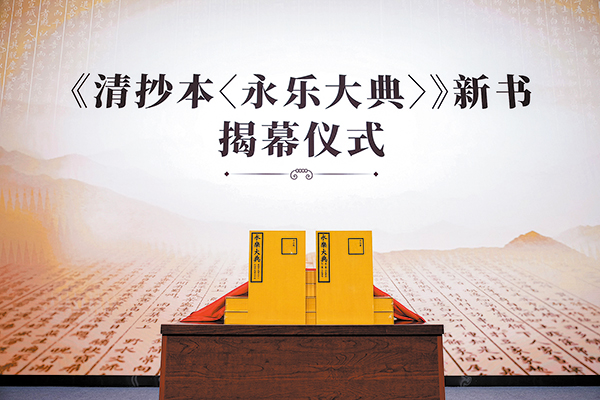
It's now possible with the newly published Qing Dynasty Manuscript Copies of the Yongle Dadian, unveiled at the National Library of China in mid-January.
"This is the closest we can get to touching what was lost," says Xu Haiyan, the project director for the newly published copies by the National Library of China Publishing House.
Produced using modern handmade Xuan paper and high-precision color printing, the volumes go far beyond conventional reproductions. They are conceived as what the publishing house describes as "experiential bridges".
Open the volume on Guangzhou, Guangdong province, for instance, one can spot in the margin a Qing Dynasty (1644-1911) copyist's note reading: "Original missing character here".
"You're witnessing the act of preservation itself," Xu explains.
This intimate connection to a scholar's hand is only possible because the facsimile captures even the faintest graphite whisper. What might be dismissed as a "blemish" in a digital scan becomes, in these pages, a conversation across centuries.
Commissioned more than 600 years ago by Emperor Yongle of the Ming Dynasty (1368-1644), Yongle Dadian was designed to be the sum of all human knowledge, a compendium of everything worth preserving from Chinese literature, history, philosophy, and medicine.
It was monumental: 11,095 volumes containing some 370 million characters.
To modern readers, scholars often offer a comparison: imagine the entirety of Wikipedia, written by hand in exquisite calligraphy, and bound into a collection that would fill a large library.

Presented by Chinaculture Registration Number: 京ICP备13028878号-4
Copyright © Ministry of Culture and Tourism, P.R.China. All rights reserved
Presented by Chinaculture Registration Number: 京ICP备13028878号-4
Copyright © Ministry of Culture and Tourism, P.R.China. All rights reserved







 京公网安备 11010502035176号