









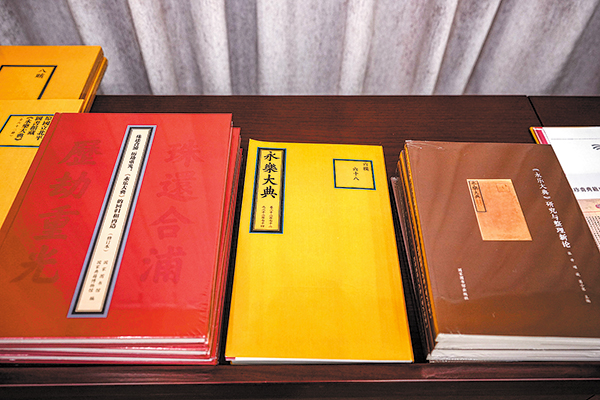
Yet, today, only about 4 percent of that colossus survives, scattered across the globe in fragments.
The original Yongle manuscript vanished without a trace centuries ago. A single surviving copy, the Jiajing duplicate commissioned by the later Ming Emperor Jiajing in the 1560s, met its own tragic fate.
In 1900, during the Yihetuan Movement (the Boxer Rebellion), the Hanlin Academy in Beijing, where the encyclopedia was stored, was engulfed by fire and looted. Volumes were burned, destroyed, or carried off as souvenirs by foreign soldiers and diplomats.
What remains are roughly 400 volumes of the Jiajing copy, housed in institutions across the United Kingdom, Japan and the United States.
For decades, the primary goal of Chinese scholars has been to simply gather and make sense of this scattered content. The National Library of China Publishing House and Zhonghua Book Company have produced comprehensive photostatic editions, allowing researchers to access texts in modern formats.
But Xu and her colleagues at the National Library of China Publishing House were pursuing something different.
"Their version is complete in content, but you cannot see the original's soul," Xu points out.
The newly released "Qing copies" are meticulous transcripts made by Qing scholars who worked directly from the Jiajing volumes when they were still accessible in the imperial library.
"The original is gone. The Jiajing copy it was based on is also gone for these sections," Xu says.
"All that's left is this later copy. It's a copy of a ghost, but it's our only ghost."
Published for the first time in a fullsize, high-fidelity color facsimile, these 18 volumes offer a double revelation.
First, they preserve unique content. One section, the Guang (Canton) chapter, contains the Gazetteer of Guangzhou, quoting from longlost local records.
For historians, it's a priceless snapshot of South China before the modern era, experts concur.

Presented by Chinaculture Registration Number: 京ICP备13028878号-4
Copyright © Ministry of Culture and Tourism, P.R.China. All rights reserved
Presented by Chinaculture Registration Number: 京ICP备13028878号-4
Copyright © Ministry of Culture and Tourism, P.R.China. All rights reserved







 京公网安备 11010502035176号