









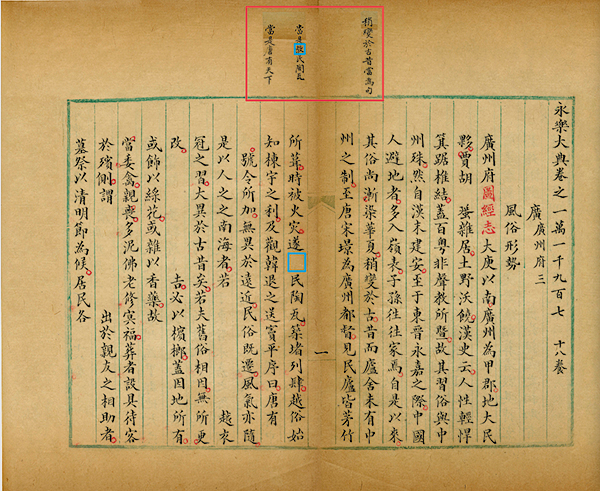
Second, these facsimiles capture the Qing copy as a historical object, including its weight, texture, and scars.
This philosophy lies at the heart of the National library press' two-decade-long Yongle Dadian facsimile project.
While Zhonghua Book Company's editions prioritize textual completeness in a portable format, the National library press employs what it calls "original-size simulation printing".
The difference is profound, says Zhang Aifang, deputy editor-in-chief of the National Library of China Publishing House.
"Our version can retain the original's beauty in layout, the elegance in handwriting, and the artistry of the illustrations," Zhang elaborates.
The pages are larger, the ruling lines vivid, the texture of the centuries-old paper almost palpable.
Xu reveals that more facsimiles bearing distinctive details are yet to be published.
She compares a page from an upcoming facsimile, showing a clean column of text, to the same page from a 2024 Zhonghua Book Company photostat.
An extra character has crept in.
"It looks like a slip introduced during the photographic process generations ago. By returning to the physical Qing copy, we corrected it," Xu says, pointing out that they are not just reproducing an image but also forensically reconstructing the most authentic state of the text.

Presented by Chinaculture Registration Number: 京ICP备13028878号-4
Copyright © Ministry of Culture and Tourism, P.R.China. All rights reserved
Presented by Chinaculture Registration Number: 京ICP备13028878号-4
Copyright © Ministry of Culture and Tourism, P.R.China. All rights reserved







 京公网安备 11010502035176号