









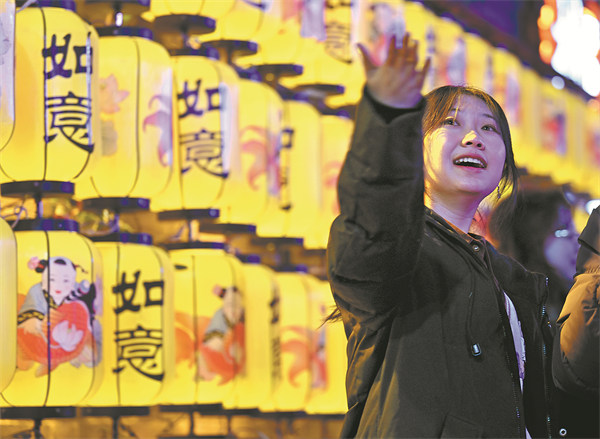
As dusk settles, the ancient town of Yangliuqing in North China's Tianjin lights up with a festive glow along the historic Beijing-Hangzhou Grand Canal.
Before reaching the main street, visitors are greeted by a joyful New Year's atmosphere: colorful lanterns and red banners adorn the town while cheerful figurines inspired by Yangliuqing's renowned woodblock paintings stand at the street entrance.
Yangliuqing woodblock painting draws on the town's rich history along the Grand Canal, once a vital trade route connecting northern and southern China. During the Ming (1368-1644) and Qing (1644-1911) dynasties, the canal carried Yangliuqing's iconic New Year paintings to every corner, spreading art and tradition far and wide.
The town's historical buildings are a luminous canvas of light, sound, and digital art. Overhead, a swarm of drones light up the night sky, creating a dazzling aerial display.
"We've created an experience that merges tradition with innovation. The event represents a creative revival of Yangliuqing's cultural heritage," said Zhu Yihai, an official from the municipal culture and tourism bureau.
"I brought my child to feel the blend of old and new," said a visitor surnamed Gao, who traveled from downtown Tianjin. "It feels both deeply traditional and wonderfully modern, and I feel like I am walking into a New Year painting."
Also adding to the immersive atmosphere is a roaming theater performance, which leads audiences through the town's winding alleys and pretty courtyards.
Visitors can follow the story of Bai Junying, a celebrated female artist in Yangliuqing's history, encountering interactive scenes along a route that links local landmarks.
"We want people to immerse themselves in the culture, not just look at the scenery," said director Zheng Yingying, adding that the performance weaves together local history, canal culture, painting traditions, and elements of Tianjin's folk performing arts, turning the audience into part of the story.
"You have to be here to understand that it's because of artists like Bai that this art form and town are alive today," said Zhu Wenjia, a spectator.
The town's cultural vibrancy also spills into its bustling markets and narrow lanes. Visitors try their hand at printing woodblock paintings or cutting paper into delicate shapes. At food stalls, families gather to make tanghulu, a popular Chinese winter snack made of crispy, sugar-coated hawthorns. Some visitors dress in traditional hanfu costumes, blending into the historic streets as they snap photos to remember their New Year celebrations.
Over the New Year holiday period, the town hosted more than 80 performances and activities, combining food, crafts, markets, lantern displays, and folk customs, according to Gao Jie, a manager with the town's tourism development company.
In recent years, Tianjin's Xiqing district, which administers Yangliuqing, has made cultural tourism a strategic focus, revitalizing historical areas to attract both visitors and investment. Since early 2025,Yangliuqing has revamped over 120 shops and 29 courtyards, making public spaces more inviting and adding cultural elements to enhance visitors' immersive experience.
"We're building a town with stories and soul," said Ren Zhenhuai, with the Xiqing district's culture and tourism bureau. "Architecture is the form, and culture is the soul. Only when the soul comes alive can the ancient town truly live."
As Chinese New Year approaches, new festive decorations and interactive installations have been added, extending the celebratory atmosphere and inviting more travelers to step into Yangliuqing's unfolding paintings, a living blend of heritage, art and renewal.

Presented by Chinaculture Registration Number: 京ICP备13028878号-4
Copyright © Ministry of Culture and Tourism, P.R.China. All rights reserved
Presented by Chinaculture Registration Number: 京ICP备13028878号-4
Copyright © Ministry of Culture and Tourism, P.R.China. All rights reserved







 京公网安备 11010502035176号