









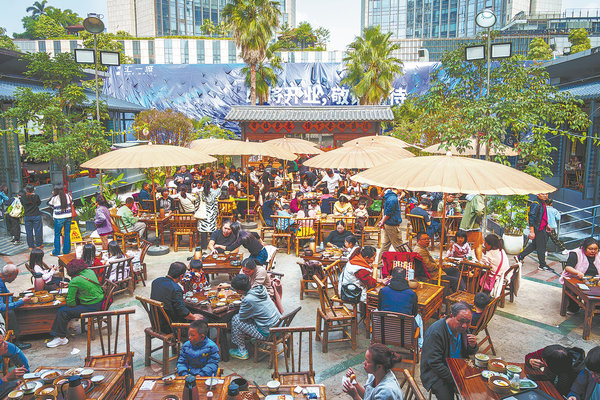
In a quiet neighborhood of Shanghai's North Bund, one can sense a subtle change in the flow of time after pushing open the door of Qiuping Tea Banquet, a teahouse that integrates tea with dining.
The space embodies a modern Chinese Zen aesthetic, featuring a light and natural palette of walnut wood and gray tones. The air carries a refined fragrance of tea, soon deepening into richer layers, as the earthy richness of oolong intertwines with savory quail eggs, the delicate sweetness of white tea woven into the texture of poached pork.
A guest's first stop is not the dining area, but a statue of Lu Yu, the revered Sage of Tea from the Tang Dynasty (618-907).
Guided by a tea attendant dressed in simple, elegant attire, whether a foreign visitor from afar or a local guest drawn by the teahouse's reputation, each person solemnly offers a cup of tea here, says Liu Qiuping, who founded the teahouse more than three decades ago.
"This is the first dialogue with more than a thousand years of tea culture, a moment of quiet ritual that settles the heart first," Liu explains.
From the tea offering and viewing the teahouse's museum-like collection of cultural artifacts relating to tea, to sitting down for an authentic tasting of the six major categories of tea, the culminating experience at the place is a full banquet where tea is integral to the cuisine.
"Many people think tea is only for drinking, but we have proven that tea can perfect a table of dishes," Liu says.
"Tea, possessing the character of 'a gentleman who helps others achieve their beauty', uses its complex aromas and inherent properties to subtly cut through grease and elevate natural sweetness, never masking the original flavor of the ingredients," she adds.
The development trajectory of this nearly 1,000-square-meter teahouse mirrors the evolution of the consumer market of China's tea culture.
Liu admits that initially, up to 70 percent of her clientele were foreign nationals and literati, drawn by this quintessential Eastern aesthetic experience.

Presented by Chinaculture Registration Number: 京ICP备13028878号-4
Copyright © Ministry of Culture and Tourism, P.R.China. All rights reserved
Presented by Chinaculture Registration Number: 京ICP备13028878号-4
Copyright © Ministry of Culture and Tourism, P.R.China. All rights reserved






 京公网安备 11010502035176号