









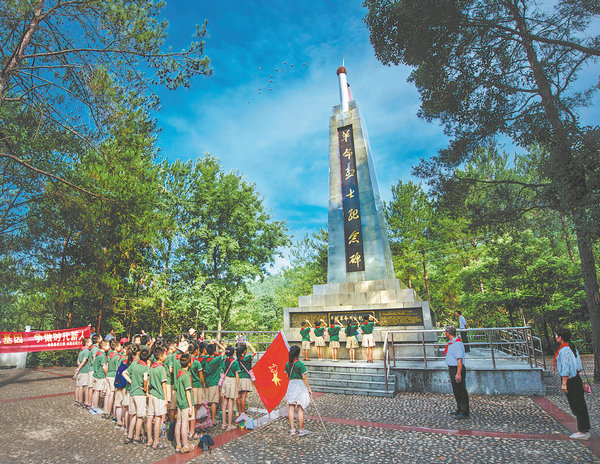
Standing atop Panshan Mountain in Huichang county, eastern Jiangxi province, the view commands instant awe. The jagged formations of Danxia rock rise sharply on all sides, the cliffs cut by time and weather into dramatic shapes. A single stone path winds its way up the mountain from the southwest.
The summit is unexpectedly flat and expansive, covered in verdant pine trees and bamboo, resembling a vast circular disk.
Zhong Weili, a tour guide in her 20s, draws our attention to a stone tablet facing the cliff and recounts a story of heroic sacrifice that is etched into the mountain itself.
"We are standing at the site where Red Army soldiers made their desperate leap off the cliff," Zhong says, her voice visibly stirred, a stark departure from the calm precision with which she had moments earlier described the surrounding landscape.
The events she recounts unfolded in April 1934, during the early stages of the Chinese Civil War. At the time, a lesser-known yet deeply heroic chapter of resistance was playing out across the Central Revolutionary Base, centered on neighboring Ruijin county in Jiangxi, covering areas in present-day southern Jiangxi, western Fujian and northeastern Guangdong provinces.
As Kuomintang forces launched a fierce attack on the Red Army's southern gateway, a small unit found itself trapped at Pangu Pass, a narrow and treacherous gap at the foot of Pangu Mountain.
For three days and nights, the soldiers fiercely resisted the enemy, inflicting heavy casualties. The rugged terrain of Pangu Mountain, with its steep cliffs and narrow paths, gave the defenders some advantage, allowing them to hold their ground.
But the balance eventually tipped. As enemy reinforcements arrived and ammunition dwindled, retreat became inevitable. To cover the withdrawal, a handful of Red Army soldiers volunteered to stay behind. When the only remaining escape route was cut off, they were cornered at the mountain's peak, with no way out.
In a final act of defiance, some soldiers volunteered to stay behind to delay the enemy. After exhausting their ammunition, they fought with rocks and their bare hands. When resistance became impossible, the remaining soldiers chose death over capture, leaping from the cliff rather than surrender.
As Zhong reaches this part of the story, her voice breaks. She falls silent for several seconds, eyes lowered, allowing the weight of the moment to settle.
Even after recounting this episode countless times over more than three years, the emotional toll remains visible.
"This story may not be as widely recognized as that of the Five Heroes of Langya Mountain (who also jumped off a cliff in 1941 to fight a Japanese ambush in northern Hebei province), but it reflects the same extraordinary bravery and sacrifice," Zhong says.
To this day, military remnants from the Pangu Mountain battle are preserved on the mountain, serving as a testament to this historic event.
Zhong says she has noticed a steady rise in visitor numbers and public awareness in recent years, thanks to local efforts to improve access and interpretation.
Panshan has undergone tangible improvements in the past few years, with infrastructure upgrades.
"This path used to be difficult to walk on, especially when it rained," Zhong explains, pointing to the well-maintained stone trail beneath our feet.
"Now, it's much wider and safer, allowing more visitors to access this important site."
Additionally, safety railings were installed and monuments restored, transforming the once muddy and hazardous trails into accessible and visitor-friendly routes.
Beyond its revolutionary history, the area is also prized for its natural beauty. Seas of clouds at sunrise attract photographers, while nearby waterways offer boat rides for leisure seekers. Zhong and her colleagues have learned to weave history into nature-based itineraries.
"During the boat ride, we discuss the Danxia landforms, and once we reach the base of Panshan, we share its red history," she says.
Panshan is only one part of Huichang's broader efforts to tap into its rich revolutionary resources and preserve its cultural heritage.

Presented by Chinaculture Registration Number: 京ICP备13028878号-4
Copyright © Ministry of Culture and Tourism, P.R.China. All rights reserved
Presented by Chinaculture Registration Number: 京ICP备13028878号-4
Copyright © Ministry of Culture and Tourism, P.R.China. All rights reserved







 京公网安备 11010502035176号