









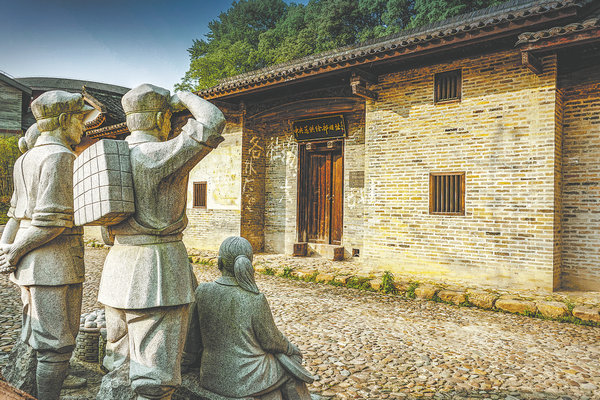
In addition to the rich collection of revolutionary relics, the park has evolved into a modern getaway. A cluster of restored traditional folk residences and intangible cultural heritage workshops bring local folk arts and Hakka traditions to life.
A waterside area has created a relaxed dining zone along the river, while new sports and recreation facilities, including an extreme-sports park and family play areas, add youthful energy to the grounds.
The science and agriculture section further expands the site's educational role by providing hands-on experiences in modern farming and rural studies.
"Our park serves two distinct visitor segments," says Hu Hongmei, a tour operations staff member.
For government and enterprise delegations focused on Party history education, the experience revolves around guided tours of eight exhibition halls and revolutionary sites like the former residences.
"These are typically one-day programs with structured learning components," she says.
For educational tours for students, a progressive program has been arranged.
"We begin with age-appropriate revolutionary storytelling, then transition to cultural experiences at our traditional Chinese culture center, and conclude with hands-on rural activities," she says.
During peak seasons, those learning programs can accommodate 500 to 600 visitors daily.
Since officially opening in June 2021, the park has received over 2 million visitors, its administration reports.
Most are study groups or red education teams from within the province, as well as those from Guangdong, Fujian, Hong Kong and Macao.
Hu says tours continue to evolve. "Educational content must be updated," she says. "We're constantly developing new courses based on real site conditions and teaching needs."
Together, Panshan and Fengjing Duhao Park form part of Huichang's "one belt, three zones" tourism development strategy.
The Xiangjiang-Gongjiang scenic belt links riverside attractions, while the southern zone offers nature and wellness, the central zone provides cultural and creative experiences, and the northern part centers on learning and rural leisure.
According to Wu Yang, deputy director of the Huichang revolutionary heritage protection and development center, Huichang is home to 67 identified immovable revolutionary relics.
Since 2016, Huichang has invested about 100 million yuan ($14.2 million) to restore 24 major revolutionary sites, including Mao Zedong's former residence.
"We encourage creative approaches to heritage use, highlighting the contemporary value of revolutionary relics," he says.
"By integrating preservation with red tourism, rural vitalization, and local industry, the county is improving public well-being and driving socioeconomic development, allowing its historic sites to speak anew," he adds.
Wu points out that Huichang's extensive revolutionary heritage remains central to understanding the region's past and its ongoing development.
"These sites help explain why Mao once called Huichang 'a place where the scenery is uniquely fine', and they continue to offer new ways for people to connect with the history that shaped our county," he says.

Presented by Chinaculture Registration Number: 京ICP备13028878号-4
Copyright © Ministry of Culture and Tourism, P.R.China. All rights reserved
Presented by Chinaculture Registration Number: 京ICP备13028878号-4
Copyright © Ministry of Culture and Tourism, P.R.China. All rights reserved







 京公网安备 11010502035176号