









Atop the mountain lie the ruins of the Yuntai Temple built during the Ming Dynasty (1368-1644), and those of the Tiankong Temple built in the Song Dynasty (960-1279).
The peaks are of various forms and slight changes in light during different weather conditions, such as fog, bring the peaks alive, a visual treat for sightseers, photographers and painters alike.
Some geologists and world natural heritage evaluation experts, who have seen so many picturesque landscapes elsewhere, had a different experience altogether while doing field work in Bajiaozhai.
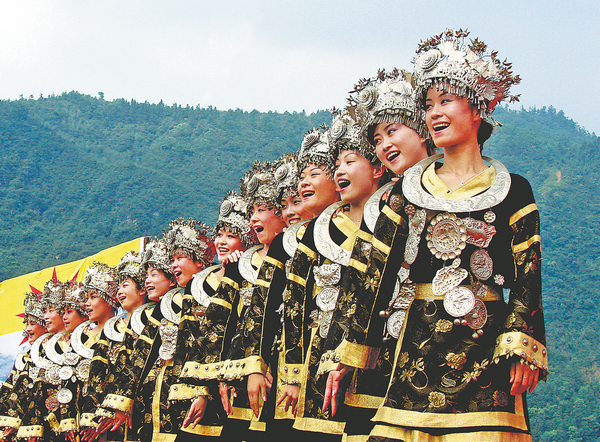
Traditional activities are organized regularly during festivals here, as both Guangxi and Hunan are home to multi-ethnic minority groups.
In Bajiaozhai, surface water has eroded red conglomerates formed 67 million years ago, during the Cretaceous period, along vertical joints, forming a rare Danxia landform landscape in the country.
With an annual temperature of 19 C, the scenic area has good vegetation and forest landscape, in which live a large number of precious plants and rare birds and animals.
In 2005, the Chinese National Geography selected Bajiaozhai as one of the most beautiful Danxia landforms in China-the others are in Guangdong, Fujian, Jiangxi, Guizhou and Gansu.
The local government attracted investors who spent 700 million yuan ($104.59 million) from 2016 to 2018, upgrading the region's infrastructure to a 4A-level national sightseeing zone (5A being the top level).
In brief, Bajiaozhai has a good combination of geology, topography, botany and anthropology, and its fresh air and pleasant temperature and humidity make it a tourist attraction throughout a year.
Li Ziyu in Guilin contributed to this story.

Presented by Chinaculture Registration Number: 京ICP备13028878号-4
Copyright © Ministry of Culture and Tourism, P.R.China. All rights reserved
Presented by Chinaculture Registration Number: 京ICP备13028878号-4
Copyright © Ministry of Culture and Tourism, P.R.China. All rights reserved







 京公网安备 11010502035176号