









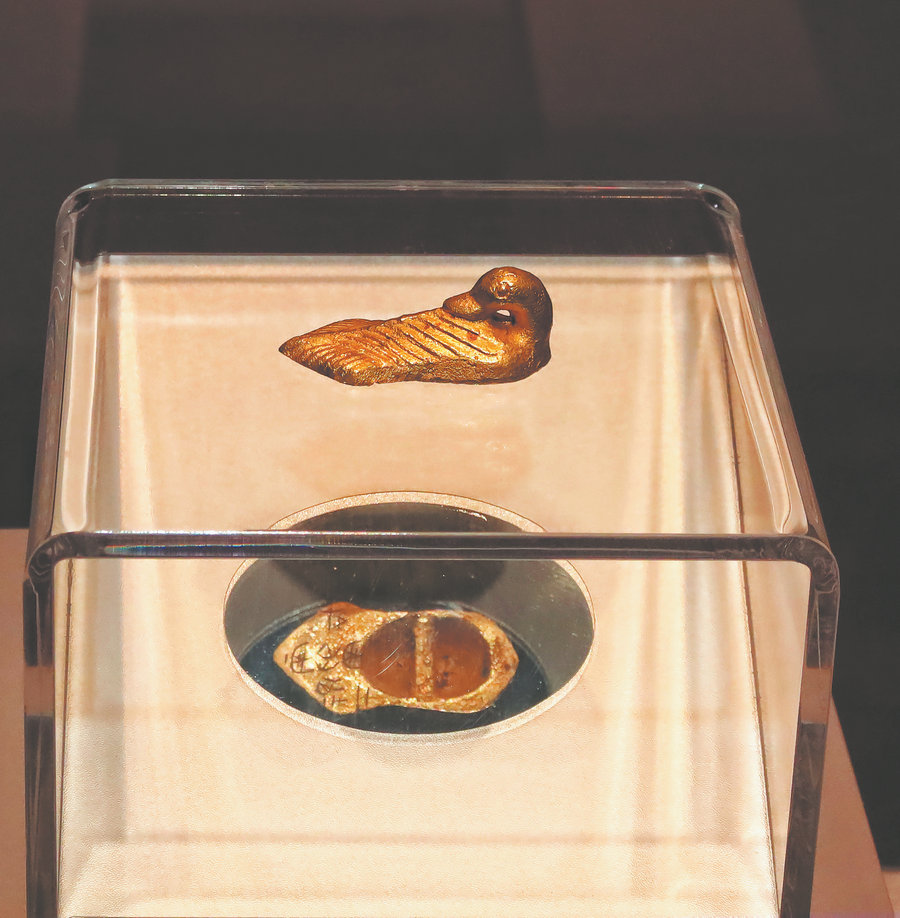
After ascending the throne, he ceded territory to Qin in hopes of easing tensions. In 241 BC, he organized a military alliance against Qin, but the campaign failed. He later moved Chu's capital to Shouchun.
Though Chu never regained its former strength under his reign, the material richness of his tomb reflects the cultural abundance accumulated over generations.
Lacquerware, in particular, reveals the state's artistic sophistication.
According to Gong Xicheng, a veteran archaeologist who heads the excavation work at Wuwangdun, Chu lacquerware is distinguished by dark backgrounds and vivid motifs — dragons, phoenixes and swirling clouds rendered primarily in red.
"The patterns and sheen of these lacquer works are well-preserved to convey composure and dignity, exemplifying the fine craftsmanship and aesthetics of the Chu state, and also providing a glimpse of its social developments," he says.
He says the construction of the tomb along with its burial assets, in the big picture, points to a pivotal moment in history, at the dawn of transitioning from complex, constant rivalries to a unified country.
King Kaolie died with unfulfilled ambitions to defeat his biggest rival and restore glory to the Chu state.
More than two millennia later, excavations at the site of his tomb were enlisted among China's top 10 archaeological discoveries of 2024, inarguably one of the highest honors for China's archaeologists.
Plans are underway to develop a cultural park at the site, bringing renewed attention to the legacy of Chu and the diversity of China's past.

Presented by Chinaculture Registration Number: 京ICP备13028878号-4
Copyright © Ministry of Culture and Tourism, P.R.China. All rights reserved
Presented by Chinaculture Registration Number: 京ICP备13028878号-4
Copyright © Ministry of Culture and Tourism, P.R.China. All rights reserved







 京公网安备 11010502035176号