









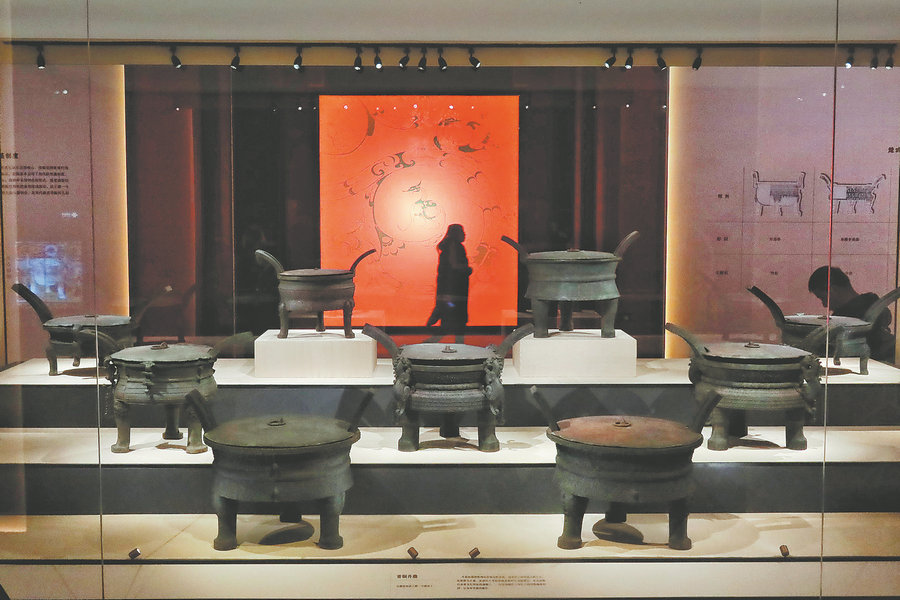
More than 2,200 years later, however, the glories and vulnerabilities of Chu have resurfaced with remarkable clarity following the identification, excavation and study of King Kaolie's burial site.
Bronze vessels, jade and gold ornaments, wooden figurines and painted lacquerware — all interred to sustain a lavish afterlife befitting royalty — are now on display at the National Museum of China in Beijing. The objects were excavated from Huainan in Anhui province, believed to be the site of Shouchun, the ancient capital of Chu, where King Kaolie's cemetery was discovered.
More than 200 artifacts are featured in the exhibition Echoes of King Kaolie: Archaeological Discoveries from the Wuwangdun Tomb No 1, which opened on Dec 26 and runs for four months. The exhibition documents excavation work that has been underway since 2020.
Gu Zhiyang, curator of the exhibition, says the findings indicate that Kaolie was buried in "the largest and highest-ranking royal cemetery of the Chu state discovered to date, and its layout, consisting of nine chambers, looks more complicated than other Chu royal tombs" found so far.
He says more than 10,000 objects have been unearthed at the site through a joint effort involving archaeologists from Anhui, the National Cultural Heritage Administration, Xiamen University and Shandong University.
"From complete sets of bronze chime bells, stone percussion instruments, and exquisite jade discs, to a lacquered table painted with dragons and phoenixes, these invaluable objects reflect the affluence of Chu's material life and rank-based burial customs," he adds.

Presented by Chinaculture Registration Number: 京ICP备13028878号-4
Copyright © Ministry of Culture and Tourism, P.R.China. All rights reserved
Presented by Chinaculture Registration Number: 京ICP备13028878号-4
Copyright © Ministry of Culture and Tourism, P.R.China. All rights reserved







 京公网安备 11010502035176号