
 |
|
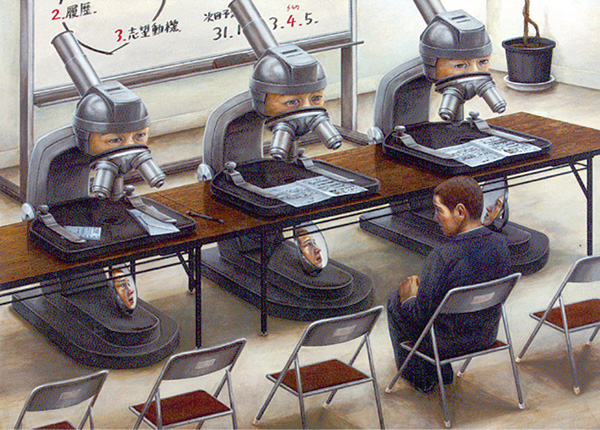
Tetsuya Ishida, Interview (1998). [Photo provided to China Daily] |
Cyberpunk has indirectly affected (and often reflected) Hong Kong's visual culture, but through refractions of novels, movies and, in particular, anime, its influence has been pervasive. The present also offers a particular prism: how the cybermetropolis has shifted from a fantastic metaphor for life in the future into an inescapable, looping present.
Far from having become outdated, cyberpunk's dystopian scenes-its protagonists, networked and yet isolated, navigate neo-noir city streets that are illuminated by the glare of commerce-look like an average night on the town in 2019, whether you're in Hong Kong, Los Angeles, Tokyo or Jakarta. Like so much that was once seen as pre-millennium "cyber" or "virtual"-as outside of us, a separate and distinct terrain to be explored or conquered in a neocolonial fashion-the realms of cyberpunk have begun to seem less like an otherworldly plane and more like a funhouse mirror of our world, lives and histories.
As part of the exhibition, Hong Kong-based art collective Zheng Mahler's 2019 installation Nostalgia Machines highlights how Asian urban spaces continue to be evoked through techno-orientalist fantasies of the West, but also in the dystopian imagining of the future in Japanese popular culture such as anime.

Presented by Chinadaily.com.cn Registration Number: 10023870-7 京ICP备13028878号-4
Copyright © Ministry of Culture and Tourism, P.R.China. All rights reserved













 京公网安备 11010502035176号