









Shanghai revitalizing classic structures with modern comfort, He Qi and Yu Yilei report in Shanghai.
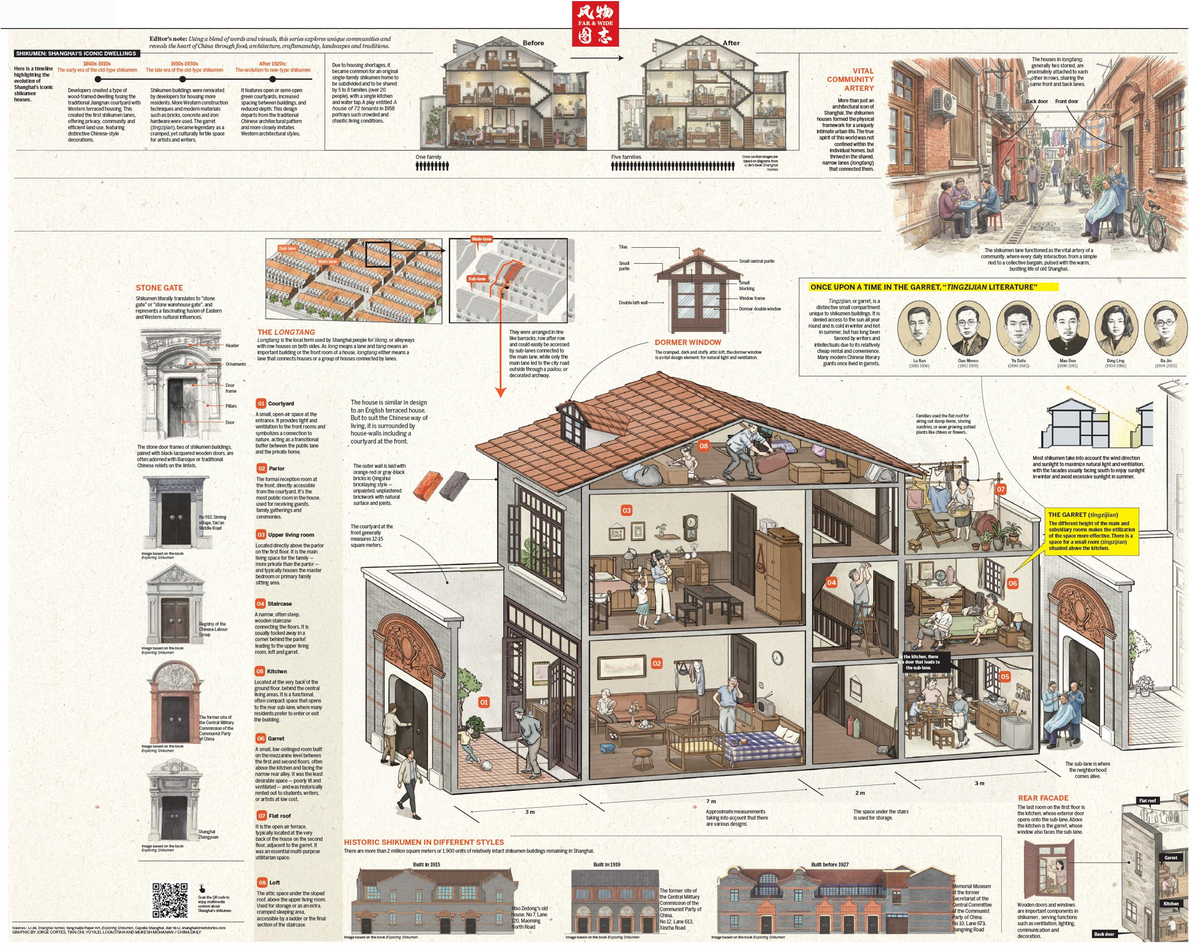
For Gu Xuefeng, a seasoned architecture expert, the essence of restoring shikumen buildings, Shanghai's typical residential housing, is not only about keeping the old look, but also adapting to a new life.
"The core of shikumen restoration is 'restoring old buildings to their original condition' — preserving their historical authenticity while adapting them to modern living," said Gu, who is general manager of Shanghai Jing'an Construction Decoration Industry Co.
Gu has been involved with major renovation projects involving shikumen complexes, including Zhangyuan, a century-old historical area initiated from a private garden, and Shen Yu Li, an early shikumen cluster built in 1932. In May 2011, the construction techniques of shikumen lilong architecture were listed as a national intangible cultural heritage.
According to Gu, national cultural heritage protection sites such as the historic Site of the Second National Congress of the Communist Party of China in Shanghai's Jing'an district must be fully preserved in their original form. However, internal modifications are permitted for some protected sites as long as the exteriors are maintained as required.
"The values of different shikumen buildings define their protection boundaries," Gu said. "It is about striking a heartfelt balance between protection and modern demands."
In his eyes, the rebirth of old buildings lies in generations of passed-down craft details. Recalling restoration techniques, Gu said:"When I first started, the intricate carvings on old building handrails were vastly different from modern concrete structures — the delicate craftsmanship left an indelible impression."
He highlighted two endangered traditional skills. The Dengcaofeng, for example, is a traditional building restoration technique specifically referring to the method of achieving ultrafine mortar joints in historical masonry. This requires brick gaps to be precisely controlled at a 5 to 6 millimeter rounded arc, and remain both aesthetic and waterproof.
"It relies entirely on the craftsman's touch. We spent over a month practicing this alone for the restoration of the Site of the Second National Congress of the Communist Party of China," Gu said.
Another skill is making Chongguang lime, a core material for lintel decoration and wall plastering.
"It is much better than ordinary lime. But the manufacturing skill used to be only passed down orally from master to apprentice," he said.
For protected shikumen still being used as public residences, Gu and his team are trying to improve the living conditions through initiatives like renovating toilets and kitchen spaces, enabling old buildings to fit modern life.
"Our work is essentially a livelihood project, balancing conservation standards with residents' genuine needs,"Gu said.
Looking ahead, Gu stressed the importance of balancing protection and development.
"Classic architectural components and historical stories must be cherished as they are Shanghai's cultural roots," he added.
Contact the writers at heqi@chinadaily.com.cn

Presented by Chinaculture Registration Number: 京ICP备13028878号-4
Copyright © Ministry of Culture and Tourism, P.R.China. All rights reserved
Presented by Chinaculture Registration Number: 京ICP备13028878号-4
Copyright © Ministry of Culture and Tourism, P.R.China. All rights reserved







 京公网安备 11010502035176号