









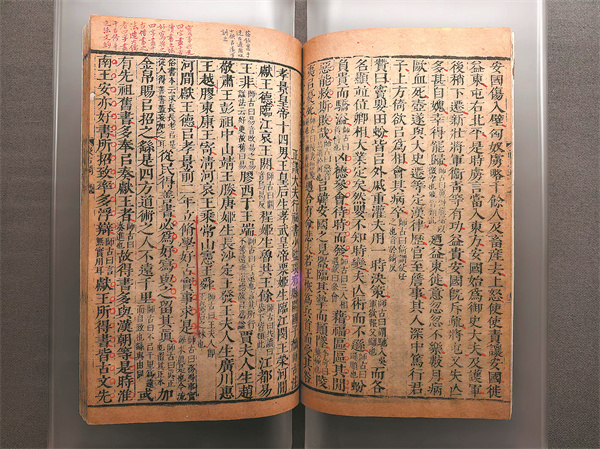
Amid the aroma wafting from book pages, the exhibition hall in the National Library of China in Beijing evokes a sense of the chanting sounds that worship Confucian sage wisdom in ancient classics throughout Chinese history.
From the Tang Dynasty (618-907) to the end of the Qing Dynasty (1644-1911), classical academies, known in Chinese as shuyuan, functioned as key educational venues for lectures, collecting, and book publishing, as well as ceremonial sites for scholars' self-cultivation.
More than 110 ancient books and other documents are on display in the Xiuxue Haogu, Shishi Qiushi: Shuyuan in Ancient Classics exhibition, which opened on Monday at the National Library. The exhibition traces the path by which these academies have sustained Chinese civilization's lasting lineage.
The theme of the exhibition, xiuxue haogu, shishi qiushi, or "be diligent in learning and reverent toward antiquity and seek truth from facts", is an excerpt from the Book of Han, written in the first century. Consciously or subconsciously, generations of traditional Chinese literati may have used this motto as a guiding principle.
A 1642 print edition of this book is also on display, with the page on which this line is written highlighted.
"Over more than 1,000 years of development, shuyuan have played a significant role in talent cultivation, academic innovation, the spread of Confucianism, and cultural inheritance," says Wei Chong, deputy director of the National Library. "Through this exhibition, we want to bring their legacies back to contemporary life."
According to Wei, over 7,500 shuyuan academies were established across China during the Tang and Qing dynasties. Though their heyday is far behind them, some traditional academies have continued to thrive. Yuelu Shuyuan in Changsha, Hunan province, is one example. This institute was the foundation of today's Hunan University.

Presented by Chinaculture Registration Number: 京ICP备13028878号-4
Copyright © Ministry of Culture and Tourism, P.R.China. All rights reserved
Presented by Chinaculture Registration Number: 京ICP备13028878号-4
Copyright © Ministry of Culture and Tourism, P.R.China. All rights reserved







 京公网安备 11010502035176号