









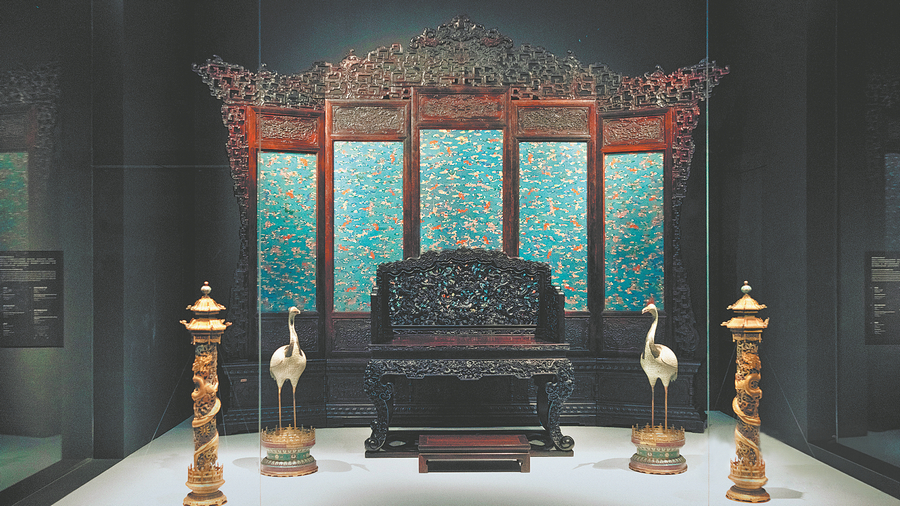
"Usually, we only appreciate the outward beauty of the artifacts, seeing them resting peacefully behind glass cabinets. This time, we dive deep into the stories behind them, about how they were protected. That enables us to cherish them even more, and understand their profoundness and cultural value," says Song Yingjie, another team member.
Ni says what strikes her most are the details of people who have devoted themselves to sheltering the museum's relics. For example, she is impressed by the temporary dwelling of the family of Ouyang Daoda, an archival specialist of the Palace Museum, in Leshan.
During the War of Resistance Against Japanese Aggression (1931-45), thousands of crates containing imperial artifacts were relocated southward to escape destruction, with some transported as far as Leshan. Ouyang was placed in charge of safeguarding one such batch.
"For eight years, he and his family members lived in the small, gloomy and cold dwelling and worked in the field like farmers while protecting the artifacts. He knew precisely which days were suitable for airing the artifacts and which items could safely be exposed to sunlight — no one else there possessed such knowledge," says Ni.
"Their unwavering dedication was guided by the principle: wherever the artifacts were, that's where their home was; wherever the artifacts were, that was where they belonged."

Presented by Chinaculture Registration Number: 京ICP备13028878号-4
Copyright © Ministry of Culture and Tourism, P.R.China. All rights reserved
Presented by Chinaculture Registration Number: 京ICP备13028878号-4
Copyright © Ministry of Culture and Tourism, P.R.China. All rights reserved







 京公网安备 11010502035176号