









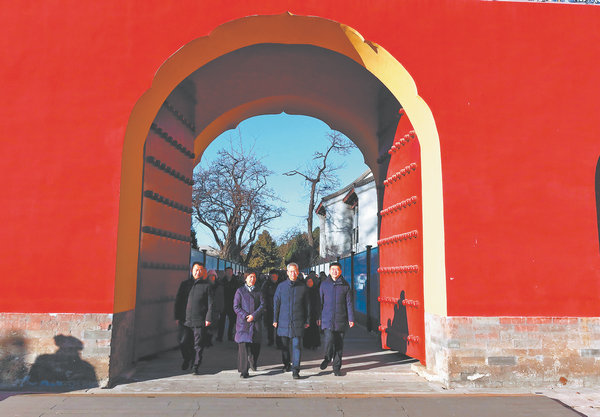
For more than 600 years, the ancient wood and stones of Xiannongtan (Altar of the God of Agriculture) have breathed with the rhythm of the seasons, bearing silent witness to imperial rites performed under the sky. On Dec 29, a new chapter opened, reconnecting threads of history long separated and allowing the altar to breathe as one sacred whole again.
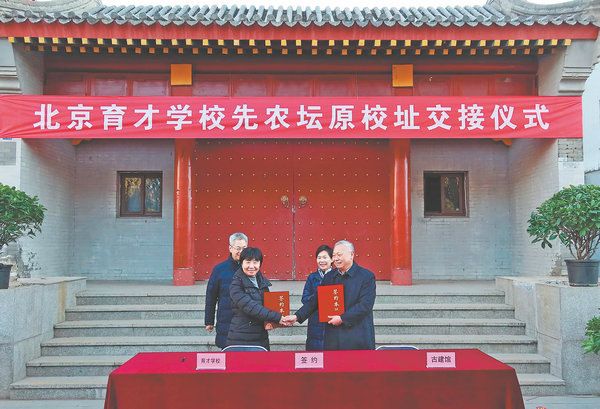
In a milestone event for cultural heritage preservation, the original campus of the Beijing Yucai School at the 600-year-old Xiannongtan temple complex was formally handed over to conservation authorities on Dec 29, marking a significant step in further restoring the Beijing Central Axis' layout.
"To support the restoration of the historical layout of Xiannongtan, the school acted in the broader public interest by vacating its original campus," Zhang Lixin, director of the Beijing Municipal Cultural Heritage Bureau, said at the handover ceremony. The school's new campus opened in September.
In 2024, Beijing Central Axis: A Building Ensemble Exhibiting the Ideal Order of the Chinese Capital was listed as a UNESCO World Heritage site. Xiannongtan, where emperors plowed a sacred field each spring to pray for bounty, is one of 15 heritage components along this 7.8-kilometer "backbone" of Beijing.
The altar is one of the five altars in the capital that were built in the early Ming Dynasty (1368-1644), alongside the altars of heaven, earth, sun and moon. It was the highest-ranking imperial site for agricultural worship during the Ming and the following Qing (1644-1911) dynasties. For over 600 years, emperors came here to perform rituals and till a symbolic field to demonstrate reverence for farming and the natural order.
The handover allows the inner and outer sections of the imperial altar to be physically reconnected for the first time in decades, with the east gate of the inner altar reopening on Dec 29.
According to Xue Jian, director of the Beijing Ancient Architecture Museum, which manages the site, the altar was built around the core idea of agrarian worship and the rites performed here reflected a philosophy of harmony between humans and nature, a hope for favorable weather and bountiful harvests through respect for the cycles of the earth.
Despite its stature, much of the complex was long inaccessible to the public, its courtyards and halls repurposed or concealed. In recent years, conservation efforts have intensified due to Beijing's bid to seek World Heritage status for the Central Axis. Since 2019, painstaking restoration has revived key sections: the Shencang storage compound, the Qingcheng Palace, and perhaps most symbolically, the emperor's sacred field.
That field had for decades been a basketball court for students at the Beijing Yucai School. Restored in 2019, it is planted seasonally and used for public cultural events, bridging ancient rituals and contemporary education.
The school's relocation, completed earlier this year, has enabled the opening of the altar's inner eastern gate, reconnecting the inner ceremonial precinct with the outer Qingcheng Palace sector.
Zhang added that after the successful inscription of the Beijing Central Axis in 2024, a three-year action plan (2025-27) was formulated to conserve the axis running through the heart of the capital, which embodies centuries of urban planning and ceremonial design. Among its 45 tasks, six relate specifically to Xiannongtan, a historical spot where emperors took off their imperial robes and donned farm workwear to perform ceremonies.
"Under the guidance and support of the Beijing Municipal Cultural Heritage Bureau, Xicheng district will continue to explore new models for heritage conservation and adaptive reuse, striving to make greater contributions to building Beijing into a national cultural center," said Zhi Haijie, head of the Xicheng District People's Government of Beijing Municipality, at the event.
The handover of the Beijing Yucai School campus, which had operated within the altar grounds since 1949, is a crucial part of the ongoing effort to vacate, protect and revitalize cultural relics within Xiannongtan. It enables integrated management and protection of the inner altar area, helps restore the site's historical appearance, and lays the foundation for future revitalization of the entire Xiannongtan complex.
"Moving forward, we will continue to promote the relocation of other units within the altar area, further restore its historical layout, expand publicly accessible spaces, and open it to society,"Zhang said.

Presented by Chinaculture Registration Number: 京ICP备13028878号-4
Copyright © Ministry of Culture and Tourism, P.R.China. All rights reserved
Presented by Chinaculture Registration Number: 京ICP备13028878号-4
Copyright © Ministry of Culture and Tourism, P.R.China. All rights reserved







 京公网安备 11010502035176号