









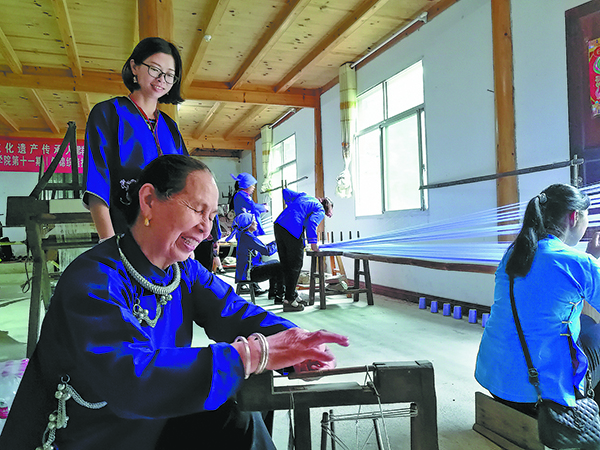
When Dong brocade was declared a national intangible cultural heritage in 2008, Ou Ruifan was elated. As a member of the Dong ethnic community in Hunan province, she felt a sense of pride that the contribution of the centuries-old craft to the country's heritage had been recognized by the authorities.
But Ou also knew that beneath the honor was an uncomfortable truth. Dong brocade craft was fading fast and on the verge of being lost. Young and middle-aged women who were the ones who traditionally did Dong embroidery were moving out of rural areas in droves to work in the cities. Most of those who were left behind to continue the weaving tradition were elderly women, many of whom struggled with failing eyesight which hindered their ability to weave. As a result, Dong brocade was gradually fading from daily life. "Many people began to view Dong brocade as dispensable at that time," Ou said.
That's when Ou decided to quit her government job and work to revive the craft. She set up a company producing and marketing Dong brocade, pouring 150,000 yuan ($21,315) of her own savings and another 50,000 yuan from venture capitalists into the start-up. The aim was to blend heritage preservation with market-oriented development.
Ou started by organizing training workshops, collecting historical artifacts, and conducting in-depth research into the history of Dong brocade and traditional patterns. The Tongdao Dong autonomous county government chipped in by supporting three rounds of Dong brocade weaving skills training. The company also received cultural industry guidance funds.
But despite the support from the government, business was slow in the beginning, and the venture capitalists were not very enthused. "The company was just starting out and they lacked confidence, so they withdrew their investment," said Ou.
Ou was unfazed by the setback, and continued to promote Dong brocade. Her efforts ultimately paid off, and the business gradually started expanding. The company now has several production bases, along with dedicated teams for research and development, processing and sales.
To expand sales, Ou has established seven branded stores and regularly participates in expos and exhibitions. The products are exported to several countries, including the United States, the Republic of Korea and the United Arab Emirates. Product launches, weaving demonstrations and fashion shows have helped reposition Dong brocade from being an ethnic artifact to a contemporary design element.
But it has not been a smooth journey. Many women weavers were reluctant to attempt technically difficult designs and preferred working on simpler traditional patterns. Ou patiently engaged with them, encouraged them to work on complex pieces, and even offered higher wages. "They gradually came to realize the need to align products with what the market was demanding," she added.
To safeguard their innovations from being copied, Ou has registered over 60 patents, copyrights and geographical indication trademarks.
For Ou, the deep connection with traditional craftsmanship and the cultural roots of Dong brocade are most important. Though her company uses new technology, she has ensured that the weaving techniques of Dong brocade are preserved.

Presented by Chinaculture Registration Number: 京ICP备13028878号-4
Copyright © Ministry of Culture and Tourism, P.R.China. All rights reserved
Presented by Chinaculture Registration Number: 京ICP备13028878号-4
Copyright © Ministry of Culture and Tourism, P.R.China. All rights reserved







 京公网安备 11010502035176号