









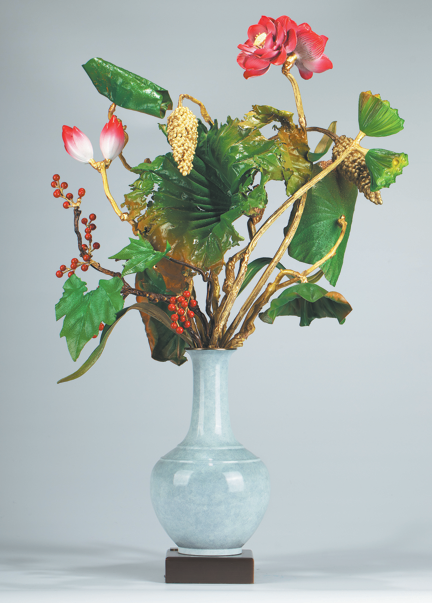
Over time, its meaning broadened to include objects for aesthetic appreciation in everyday spaces, including porcelain vessels, incense burners and vases, as well as flowers and fruits that were valued for their fragrance or auspicious symbolism.
Zhu Junmin has donated four such qinggong-themed copper sculptures to the National Museum of China. "The qinggong art embodies scholarly aesthetic preferences — it derives from potted flower arrangements and painted hangings, which were popular leisurely activities among elite intellectuals in the Song Dynasty (960-1279). As a citizen of Hangzhou, the imperial capital of the Southern Song Dynasty (1127-1279),I owe my work as a tribute to Song aesthetics."
He says that today, qinggong motifs reflect the wishes for prosperity and peace of ordinary people.
The father and son have sourced methods from many fine arts and crafts in history, such as the techniques of cobalt blue-and-white (qinghua) porcelain and painted enamel. They have integrated these into their work, turning objects into manifestations of not only copper art but also the entirety of Chinese culture.
Zhu Bingren says that when learning from their predecessors, "people today also need to learn from the world, to innovate, and to leave some wisdom for the following generations".

Presented by Chinaculture Registration Number: 京ICP备13028878号-4
Copyright © Ministry of Culture and Tourism, P.R.China. All rights reserved
Presented by Chinaculture Registration Number: 京ICP备13028878号-4
Copyright © Ministry of Culture and Tourism, P.R.China. All rights reserved







 京公网安备 11010502035176号