









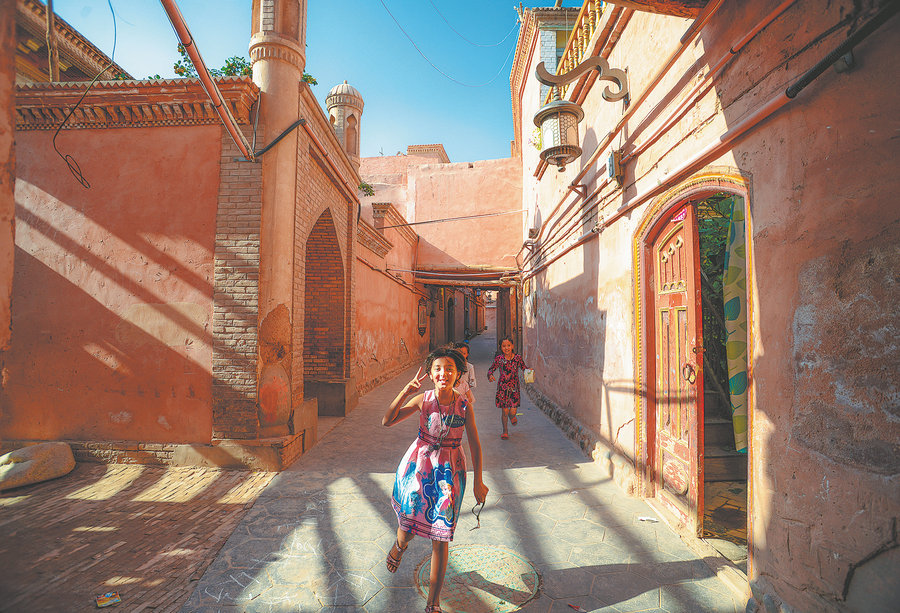
Spirit of openness
Xinjiang, historically known as Xiyu (Western Regions), was formally included in Chinese territory during the Han Dynasty (206 BC-AD 220). After that, dynasties in the Central Plains regarded the region as part of their territory and exercised jurisdiction.
The region strategically lies at the crossroads of major ancient civilizations. To the east, it connects to the Central Plains through the Hexi Corridor, the main artery of the ancient Silk Road in Gansu province. To the west, crossing the Ili River Valley along the northern foothills of the Tianshan Mountains opens the way to Central Asia.
Traversing the Pamirs leads into the Fergana Valley and onward toward South Asia and the Mediterranean. To the north, the Altay Mountains serve as a gateway to the vast Eurasian Steppe and further to Eastern Europe.
Through trade and cultural exchanges along the ancient Silk Road, the Western Regions gradually became the primary route for the Central Plains' dynasties to engage with Central Asia, West Asia and Europe, serving as a convergence point for various civilizations.

Presented by Chinaculture Registration Number: 京ICP备13028878号-4
Copyright © Ministry of Culture and Tourism, P.R.China. All rights reserved
Presented by Chinaculture Registration Number: 京ICP备13028878号-4
Copyright © Ministry of Culture and Tourism, P.R.China. All rights reserved







 京公网安备 11010502035176号