









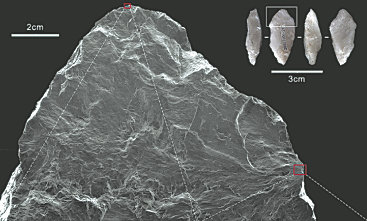
The latest discoveries in Central China's Henan province are filling critical gaps in understanding East Asia's role in human evolution during a key period of the Paleolithic era, shedding light on how ancient inhabitants adapted to fluctuating environments.
Studies on the 2,601 stone artifacts unearthed from the newly excavated Xigou site in Nanyang, Henan, dating back 160,000 to 72,000 years, reveal systematic small stone-flake production strategies and the earliest-known evidence of tool-handling technologies in East Asia. The findings challenge the long-held view that East Asia was less inventive and adaptable than its counterparts elsewhere between 300,000 and 50,000 years ago.
The breakthrough was achieved by multidisciplinary research conducted by more than 10 academic research institutes at home and abroad, led by the Institute of Vertebrate Paleontology and Paleoanthropology under the Chinese Academy of Sciences in Beijing.
Their findings were published on Wednesday in the scientific journal Nature Communications with the title "Technological innovations and hafted technology in central China from 160,000 to 72,000 years ago".
Researchers say that the period from the late Middle Pleistocene to the middle Late Pleistocene, spanning 300,000 to 50,000 years ago and characterized by significant environmental instability, was crucial in human evolution, as it not only witnessed the evolution and adaptation of Homo sapiens, but also possibly recorded their coexistence and interactions with Neanderthals, Denisovans and many other related human groups.
In previous research focusing on Africa and the western area of the Eurasian continent during this period, archaeological studies often linked humans' complicated evolutionary processes to a series of symbolic activities and technological innovations.
By contrast, stone tool assemblages found in East Asia were long regarded as simple, leading scholars to characterize the region as conservative in its cultural development, with major technological changes thought to have begun only about 40,000 years ago.
That understanding is now being revised with the release of the latest discoveries.
Yue Jianping, a member of the research team from the Chinese Academy of Sciences, says technological analysis reveals that prehistoric inhabitants in this region were able to produce small flakes with sophisticated stone tool-making methods.
These included core-on-flake techniques — where a previously detached large stone flake served as a core for crafting smaller, specialized flakes, as well as discoid technology. In the latter method, a lens-shaped core was systematically struck from its perimeter toward the center to serially produce small, sharp cutting flakes, both showing planned technological organization.
Using these flakes as raw materials, ancient toolmakers produced a range of implements including scrapers, drills and engravers.
Researchers note that during this period, East Asia experienced significant climate fluctuations and ancient humans seemed to adapt to the environment by developing diverse stone tool technologies.
More importantly, researchers discovered some stone tools were hafted, marking the earliest known evidence of composite tools in East Asia. They also traced two different handle types through traceological analysis. These tools combined stone components with handles or shafts, and demonstrated complex planning, skilled craftsmanship, and an understanding of how to enhance tool performance, Yue says.
Yang Shixia, a researcher involved in this project, says this constitutes the earliest evidence for composite tools in East Asia confirmed through both technological and traceological analyses. This discovery pushes back the timeline for hafting technologies in the region by tens of thousands of years.
The discovery at the Xigou site is not an isolated case. Yang says in recent years, evidence related to complex human activities has been uncovered from many Paleolithic sites in China, including the Lingjing site in Xuchang, Henan, where researchers have documented discoid technology, bone tool production and the use of ocher.
Together with other evidence, the new discovery is reshaping the traditional narrative of human activity development and environmental adaptation in East Asia, she says.

Presented by Chinaculture Registration Number: 京ICP备13028878号-4
Copyright © Ministry of Culture and Tourism, P.R.China. All rights reserved
Presented by Chinaculture Registration Number: 京ICP备13028878号-4
Copyright © Ministry of Culture and Tourism, P.R.China. All rights reserved







 京公网安备 11010502035176号