









Gliding across time
Indeed, it's tricky — if not impossible — to walk through so much snow. So, since ancient times, people have instead glided over it.
Prehistoric petroglyphs in Altay portray what may be humankind's earliest depictions of skiing.
Yunxiao Peak takes this legacy to new heights and lengths, as the top spot in the Jikepulin International Ski Resort, which is crisscrossed by 103 ski trails totaling 108 kilometers.
The Keketuohai trail claims to be Asia's longest at 11.2 km, and the 4.93-km cable car to Yunxiao's zenith is reportedly China's longest at a ski destination.
Experiences extend beyond whooshing downhill. Visitors waddle along snowshoe paths, drill holes for ice fishing and hike through primeval forests.
A relic of the region's millennia-old skiing legacy rests forsaken but not forgotten in a corner of Hemu's Century-Old Cabin — a set of horse-fur-sheathed pinewood skis with cattle-leather cordage to tie them to users' feet.
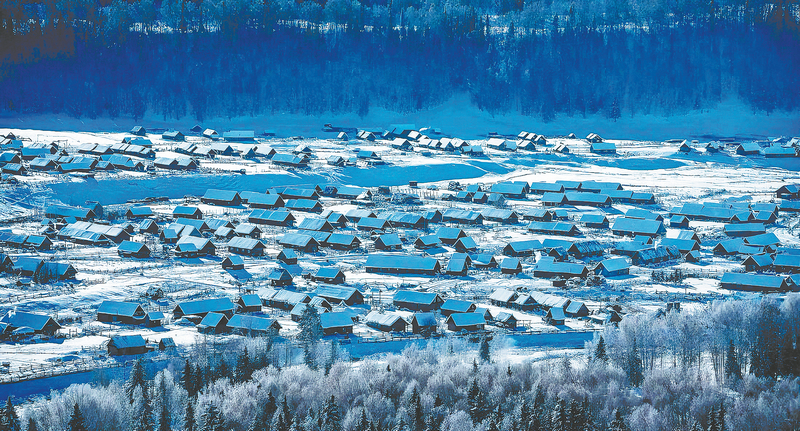
The shelter, originally erected by Russian settlers as three classrooms 124 years ago, has become an exhibition hall of traditional culture. It was rebuilt according to the initial design, using old logs repurposed from an office, school and barn.
On the windowsill, a simple wooden candlestick testifies to winters hunched indoors, its wax drippings layering memories of dark days like geological strata.
Sitting in another corner is a vessel chiseled from a hollowed-out log with a square hole punched into its side — the spigot for kumis, a mildly fizzy, slightly alcoholic beverage made from fermented mare's milk.
Sheep stomachs, like those hanging near a window, are still used to carry horse milk, and birchbark canteens slosh with butter tea. A shiny, crinkled cowhide sack and a horsehide pouch that dangle from wall pegs are used to ferment yogurt or transport water.
A handmade wooden cradle testifies to a harsh practicality that suffers little sentiment in an unsympathetic wilderness, where function trumps feelings. Its severe design features a bed of wooden planks with a hole for a toilet. Infants' calves were tied to the sides to prevent them from becoming bowlegged, even before they had begun life in the saddle or on skis.
A comparably hard and unyielding saddle hewn from raw timber hangs on the wall. This seat would offer the rider some support but little cushioning during long journeys across Altay's unforgiving expanses.
Every showcased item is an answer to a question posed by the chilly massifs' cold indifference. How do you carry your milk, your child and yourself across the snow? How do you extract shelter, light and food out of a realm hardened by ice and rock?
The Century-Old Cabin doesn't just present heirlooms but preserves a complete working logic for improbable survival.
Its design is typical of houses in Altay's Kanas region.
Roughly 40-centimeter-thick red pine logs are stacked to form walls that extend underground, and moss is packed in the spaces between for insulation. Residents regularly moisten this mortar so that it not only remains viable but also grows to generate living walls that better seal out the biting winds.
Roofs are steep-pitched so that snow slides off before the beams buckle. The gables can be detached in the summer to enjoy sunshine and reattached if it rains, like the top of a convertible.
Hemu's cabins don't just rebuff the elements outdoors but also control the climate indoors.
In this frigid domain, weather is the architect, drafting blueprints for both the way of life and its refuge.

Presented by Chinaculture Registration Number: 京ICP备13028878号-4
Copyright © Ministry of Culture and Tourism, P.R.China. All rights reserved
Presented by Chinaculture Registration Number: 京ICP备13028878号-4
Copyright © Ministry of Culture and Tourism, P.R.China. All rights reserved







 京公网安备 11010502035176号