









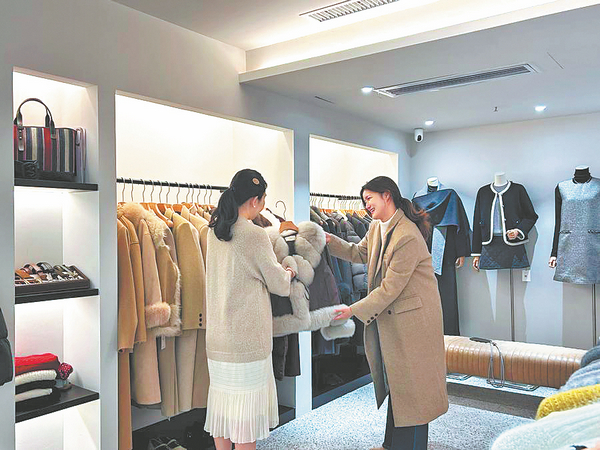
TIANJIN — In the bustling Wanglanzhuang Wenzhou International Trade City in North China's Tianjin, shoppers streamed through aisles in search of New Year outfits. Among the shops, a fashion boutique stood out, its chic displays and vibrant colors drawing attention.
The shop's owner, Sung Ha Rim, a poised young entrepreneur from the Republic of Korea, dressed in a minimalist suit, greeted visitors in fluent Chinese, offering styling tips with a warm smile.
"China is where my career thrives; it has long become my home," she says.
Sung moved to Guangzhou in southern China with her family at the age of 9. Raised in a family of garment traders, she gained early exposure to the industry, absorbing the language of fabrics, patterns and cuts while helping out at her parents' shop.
After studying communications at Shanghai Jiao Tong University, she launched her own clothing brand in Guangzhou in 2018, focusing on wholesale.
"Starting a business in a foreign land was challenging, especially learning local laws and taxes, but government support eased the process," she recalls. She credits China's vast market potential and efficient supply chains for her success. "The opportunities here are limitless. People worldwide can find their foothold," she notes.
Her collaboration with Chinese manufacturers has been highly effective. "They are pragmatic, efficient and offer tailored solutions, thanks to China's robust production capabilities," she explains.
As her client network expanded across China, Sung was approached by Kim Kyung Tak, a manager also from the ROK at the Tianjin mall, who offered incentives including a year of rent-free space and branding support.
"Tianjin's strategic location and consumer-friendly policies convinced me to explore the northern China market," she says.
After three exploratory visits, Sung relocated part of her business operations to Tianjin in the autumn of 2024, bringing 450 kilograms of clothing. She meticulously oversaw everything from fabric sourcing to sales data analysis."Running a fashion brand is like raising a child; neglect it, and the market will respond," she says.
Her Tianjin store quickly gained popularity, joining a thriving ROK merchant community that attracted young shoppers from across northern China.
Frequently shuttling between Guangzhou and Tianjin, she says,"Though the stores are 2,000 kilometers apart, China's advanced transport makes management easy." She also hailed the visa-free entry policy, saying it has boosted bilateral exchanges. "These opening-up measures make long-term development in China more secure."
With China-ROK trade hitting $328 billion in 2024, Sung expresses optimism. "China's expanding openness, exemplified by initiatives like the Hainan Free Trade Port, creates ideal timing for international growth," she says, noting that her clothing now reaches clients as far away as Russia.

Presented by Chinaculture Registration Number: 京ICP备13028878号-4
Copyright © Ministry of Culture and Tourism, P.R.China. All rights reserved
Presented by Chinaculture Registration Number: 京ICP备13028878号-4
Copyright © Ministry of Culture and Tourism, P.R.China. All rights reserved







 京公网安备 11010502035176号