









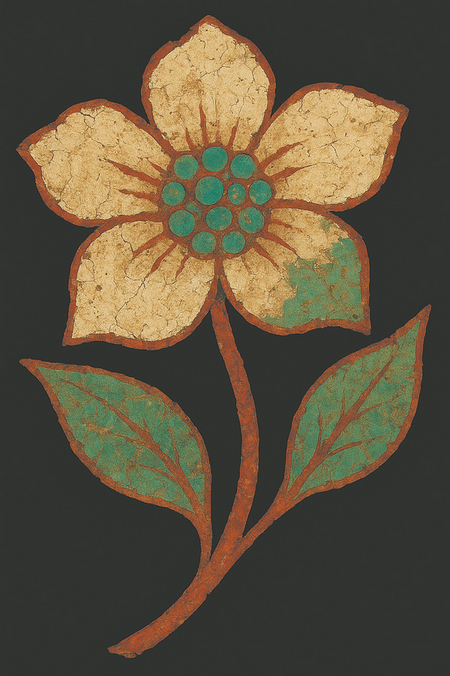
Her inspiration came through carpets, studying motifs from her hometown, the Xinjiang Uygur autonomous region, to Azerbaijan, seeing how one art form connects countries and regions involved in the Belt and Road Initiative.
"It confirmed that the gene is the essential unit for quantifying, calculating, and, crucially, for revealing patterns of evolution through time and space," she says.
Zhao's team has since defined six core categories of cultural genes: patterns, colors, music, dance, crafts and forms. In their database, a dragon motif from a Ming Dynasty (1368-1644) robe isn't just an image in a museum; it's a data node linked to its mathematical structure, related architectural forms and modern design applications.
The practical work is vast and formidable. Partnering with 54 museums, including the Palace Museum in Beijing and the Shanghai Museum, Zhao's lab has interconnected more than 1.3 million digital artifacts and patterns, using AI to analyze and tag items with deep, contextual labels.
They've cataloged more than 90,000 dragon patterns and about 7,740 phoenix patterns from the Palace Museum's collections — conducting large-scale analyses that had never been undertaken.

Presented by Chinaculture Registration Number: 京ICP备13028878号-4
Copyright © Ministry of Culture and Tourism, P.R.China. All rights reserved
Presented by Chinaculture Registration Number: 京ICP备13028878号-4
Copyright © Ministry of Culture and Tourism, P.R.China. All rights reserved






 京公网安备 11010502035176号