









Bonded by food
Lee also shared some stories about the immense influence of those Chinese settlers on the cultural, economic and demographic landscape of Fiji, especially in its rural and maritime provinces.
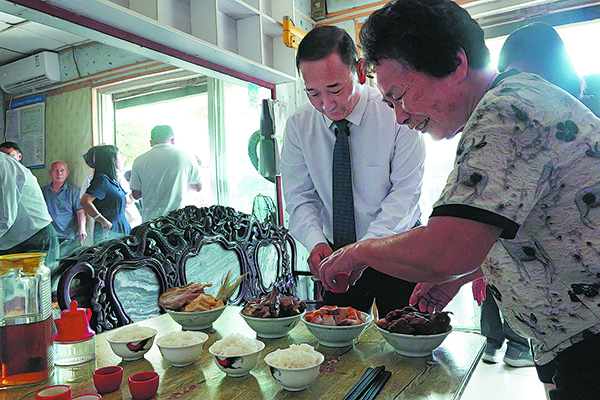
During his visit to his ancestral hometown in Zhongshan in July, the ambassador saw cooking techniques and cultural elements that are similar to those one finds in the Fijian countryside.
"In connecting the dots, we can see that those traditional culinary skills that we took for granted in Fiji as part and parcel of a unique cooking style in some of our rural provinces, actually had their roots in Zhongshan and Jiangmen," Lee said.
For example, "banana" in the Fijian language is the English word "China", according to the ambassador.
He explained that the first Chinese settlers arrived in Fiji in 1855, and bananas arrived in the country around 20 years later. By the early 1900s, the Chinese people were deeply involved in the growing, harvesting and trading of the fruit.
Lee added that a culinary specialty of Fiji is "bila" (a fermented bread), which is wrapped in banana leaves before being cooked.
While bila is now considered a traditional Fijian food, Lee learned during his visits to Guangdong that the use of banana leaves to wrap food before it is cooked is a cooking technique from Guangdong and was brought to Fiji by early Chinese settlers.
"Hence, it is easy to understand why bananas are referred to as 'jaina' in the i-Taukei, or Fijian language," he said.
Another anecdote relates to a recent reception marking the 50th anniversary of bilateral ties between China and Fiji, which was held in Beijing in October.
There, the Fijian people performed the country's traditional kava ceremony for Lee and Shen Xin, vice-president of the Chinese People's Association for Friendship with Foreign Countries.
Kava is a traditional drink in Fiji made from the kava plant, and it is served during official events and in social gatherings.
The guests were intrigued by the ceremony as they noticed two small bowls that contained dried salted plums, which are known in Mandarin as huamei, and are a popular snack in China.
Lee said that after drinking a few cups or bowls of kava, a common practice in Fiji is to eat a piece of huamei.
"This practice was introduced by the Chinese settlers from Guangdong province over a hundred years ago. It was a way to re-salivate the mouth from the numbing and drying effect of kava," Lee said, adding that huamei is referred to as "Chinese lolly" in Fiji.
"Imagine and picture this situation: Many a Fijian visiting China is often shocked to find that no one in China understands what they are saying, when asked where they can buy 'Chinese lolly'," he laughed.
Recently, Sitiveni Rabuka, the Fijian prime minister, showcased a book written by Fijian entrepreneur Joe Banivanua Mar. Titled Kai Jaina — A World Between, it is a memoir in which he writes of the complexities of belonging and balancing the rich cultural heritage of his Fijian and Chinese ancestry.
"It is a part of the rich history of the Chinese in Fiji, the stories that have never been fully captured in our written history," Lee said.

Presented by Chinaculture Registration Number: 京ICP备13028878号-4
Copyright © Ministry of Culture and Tourism, P.R.China. All rights reserved
Presented by Chinaculture Registration Number: 京ICP备13028878号-4
Copyright © Ministry of Culture and Tourism, P.R.China. All rights reserved







 京公网安备 11010502035176号