









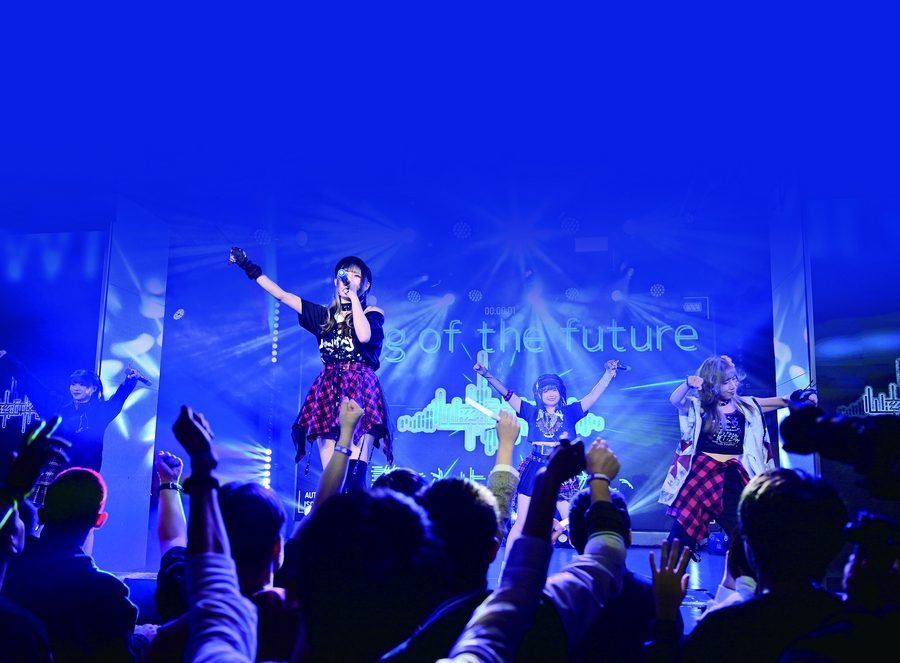
Under flickering lights and amid the synchronized cheers of the audience, Mubing (her stage name) and her teammates delivered a lively singing and dancing performance. Sweat dampened her hair, yet she wore a bright smile throughout.
It was a Friday evening in winter at Mask Stage, a small live house in Beijing, where Mubing, from Guangzhou in Guangdong province, joined about 60 girls from various "underground idol groups" for a two-hour multi-group show.
Originating in Japan, the underground idol industry focuses on local performances, and the community is tightly knit. At these shows, the audience's energy often matches — or even rivals — that of the performers. Fans chant customized slogans for each idol and perform coordinated support moves. When excitement peaks, some attendees are even lifted by others in an act known as "taking flight".
The "meet-and-greet" session after the show captures the essence of this underground culture. For 60 yuan ($8.48), a fan can buy a ticket for a two-minute, one-on-one interaction with their idol. During this time, Mubing would usually take an instant photo with her supporter and share a brief chat.
Over the past year or two, similar scenes have been unfolding in venues across the city every weekend and on some weekday nights.
According to data from "China Idols Wiki", 91 new underground idol groups were formed in China in 2023, earning that year the title of the "birth year of Chinese underground idols". The numbers continued to grow in 2024 and 2025, with 25 new groups emerging in just the first two months of this year.
Mubing's group, Dokispeed, debuted in October 2023. The team currently has five members: two college students, two part-time workers, and Mubing, the only full-time idol in the group.
Mubing's decision to become an underground idol stems from both a long-standing passion and strong family support. She has been a fan of idol culture since middle school. After graduating from university, her family did not impose financial pressure on her. Instead, they agreed that she should pursue work that she truly loves and for which she has a clear sense of direction.
Still, Mubing admits that income as an underground idol is far from stable. Revenue from show tickets usually goes to organizers and venues, while idols mainly earn through meet-and-greet ticket sales.
Depending on their popularity, earnings can range from a few hundred to several tens of thousands of yuan per month.

Striving solo
Unlike idols supported by agencies, 20-year-old Yan Yufan (stage name Yumi) from Weinan, Shaanxi province, is a "self-operated" underground idol.
She handles everything herself — from designing her persona and generating pre-debut buzz to finding performance opportunities.
Yumi acknowledges that she is at the bottom of the industry hierarchy when competing for show slots. "Idols with agencies are prioritized over self-operated idol groups, and at the very end come solo self-operated idols," she said.
Yet she remains grateful for the underground idol scene's low entry barriers and inclusivity. Yumi debuted in 2023, right after high school, at an idol random-dance event in a shopping mall in her hometown.
"As long as you have a dream and are willing to train hard, even ordinary people can take the stage," she said. "It's an open path for anyone who is eager to perform."
Typically, each underground idol has a defined persona and support color. Yumi, for example, has crafted her image as a "little bird that can rewind time", even designing stage costumes featuring a pair of wings. She chose a rainbow color scheme — reminiscent of a parrot's feathers — as her support color.
"I hope all these elements can create a kind of utopia where people leading tired lives can briefly forget their worries," she said.
This is exactly what Yumi loves most about being an underground idol. "It makes me feel that, beyond the trivialities of everyday life, there's a more capable, more vivid version of myself. The me on stage is the me I aspire to be. In those moments, I truly feel like an amazing person," she said.
For Yumi, the heart of her career lies in the close connection she builds with her fans. One of her most memorable moments came during a performance in Shanghai, when a fan traveled all the way from Hefei, Anhui province, by train just to support her.
"I turned around and saw him in the front row wearing my support T-shirt. That familiar presence instantly wiped away my nervousness," she recalled. "An underground idol's performance is only complete with the support of the audience. Fans are our comrades-in-arms on this journey."

Emerging industry
Wei Yuxin, 31, from Xinzhou, Shanxi province, has also discovered her passion and drive in the underground idol industry.
A former clinical medicine graduate from Peking University and ex-employee of a major internet company, she made what she calls an "alternative transition" — leaving a conventional career path to pursue the emerging world of underground idols.
While at university, she participated in cover performances of the Japanese idol group AKB48. Later, she worked part-time as an underground idol and eventually founded Beijing's largest underground idol agency, Dokiclub, which manages four groups with a total of 24 idols, including Mubing.
Having experienced the full spectrum of the industry, Wei offers keen insights into the field. She noted that Shanghai is widely recognized as the "top city", with the highest level of commercialization and the densest performance schedule. Beijing follows closely, with shows now taking place almost daily. In second- and third-tier cities, self-operated groups and individual idols dominate the scene.
In terms of promotion, the path in China differs from that in Japan. "A characteristic of the Chinese market is that online platforms feed into off-line activities," Wei explained.
This means many groups first build an initial fan base through sites like Bilibili and Douyin before organizing off-line events.
Currently, Sina Weibo and Xiaohongshu serve as the main operational channels for underground idols, while livestreaming is an area Dokiclub hopes to expand into in the future.
Although competition in the market is becoming increasingly fierce, Wei believes the core criteria for selecting idols are straightforward. Beyond a genuine love for performing, the ability to bring happiness to others is equally important because one of the key distinctions between underground and mainstream idols is a sense of closeness.
"You either have to be exceptional on stage or excel at engaging with people — being fun, sincere, and likable," she said. "There must be at least one quality that makes fans feel happy just by seeing you."
While devoted to her career, Wei also sees hidden challenges beneath the industry's apparent prosperity.
One major issue is an over-reliance on a single business model. Dependence on income from meet-and-greet sessions limits the industry's growth potential.
Another challenge is the insularity of the fan base. Currently, underground idol fans are largely limited to a small circle already interested in the subculture. Wei hopes to broaden the audience through cross-community collaborations with groups such as the ACG (animation, comics, and games) community and voice actors.
A lack of industry standards continues to be a persistent problem. There are still no established guidelines for contracts, idol safety, or fan behavior.
Despite these hurdles, Wei remains cautiously optimistic about the future of China's underground idol scene. In her view, professional operations and content with distinct Chinese characteristics — especially original Chinese-language works — are crucial for future development.
"China's underground idols are not merely a replication of the Japanese model. They are evolving into a unique and vibrant branch of Chinese youth culture, with their own life force," she said.
guiqian@i21st.cn

Presented by Chinaculture Registration Number: 京ICP备13028878号-4
Copyright © Ministry of Culture and Tourism, P.R.China. All rights reserved
Presented by Chinaculture Registration Number: 京ICP备13028878号-4
Copyright © Ministry of Culture and Tourism, P.R.China. All rights reserved







 京公网安备 11010502035176号