









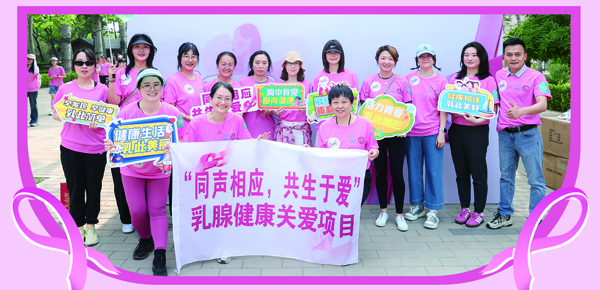
From awkward silence to open conversations, a Beijing campus is making breast health a normal topic for everyone.
When 19-year-old Zhang Jingyan signed up for a breast health awareness event at her university, she hesitated.
"My roommates felt uncomfortable even hearing me say the word 'breast' out loud and didn't want to join," said Zhang, a student at the University of International Business and Economics (UIBE) in Beijing.
Despite the awkwardness, she decided to take part. Held on May 21 and co-hosted by the China Women's Development Foundation and the university, the event transformed the campus with pink ribbons and the enthusiasm of hundreds of students and faculty members.
Designed in a unique "science plus exercise" format, the campaign combined breast health education with quizzes and games, aiming to help young people break the silence and long-standing taboos surrounding women's health.
Dong Kui, vice president of the foundation, said the initiative not only provides rehabilitation support for patients in need but also seeks to promote a new wave of health awareness among young people through collaborations with universities.
Zhang Xiaofeng, deputy secretary of the university's Party committee, emphasized that health education would become a regular part of the curriculum to bring youthful energy to the broader goal of building a healthier China.
During the event, Yuan Peng, a chief physician at the Cancer Hospital of the Chinese Academy of Medical Sciences, presented some alarming data: China reports 420,000 new cases of breast cancer each year, with a rising number of younger patients.
She stressed the importance of "early detection, early diagnosis, and early treatment", urging young women to perform monthly self-exams and get regular screenings. "If caught early, the five-year survival rate exceeds 90 percent," Yuan said. "But for late-stage cases, that figure drops below 15 percent."

Presented by Chinaculture Registration Number: 京ICP备13028878号-4
Copyright © Ministry of Culture and Tourism, P.R.China. All rights reserved
Presented by Chinaculture Registration Number: 京ICP备13028878号-4
Copyright © Ministry of Culture and Tourism, P.R.China. All rights reserved






 京公网安备 11010502035176号