









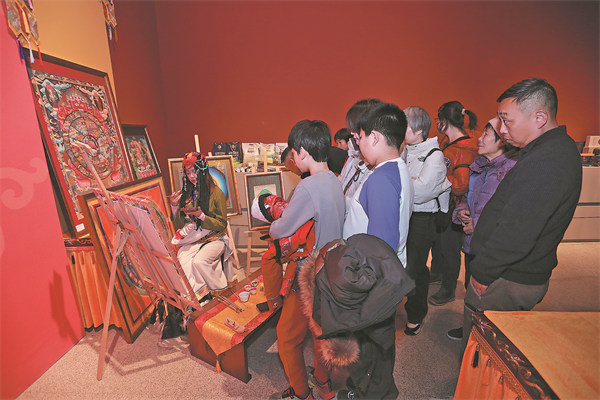
From the sacred silence of monastery walls to the dynamic narratives of modern history, the ancient art of Langkajie thangka is stepping into a bold new era. An exhibition unveiled on Tuesday at the Chinese Traditional Culture Museum in Beijing presents a profound reimagining of this centuries-old Tibetan craft, transforming it into a vibrant visual chronicle of a community's collective memory.
The exhibition Red Memory Engraved in Thangka: The Innovative Art of Langkajie Thangka showcases more than 60 works created in the past decade. These pieces are a departure from traditional religious iconography, documenting the history of Luhuo county in Sichuan province, the birthplace of master painter Langkajie 300 years ago.
Utilizing the classical language of Tibetan scroll painting, renowned for its "exquisite, saintly detail" and luminous mineral pigments, the artists capture pivotal moments from the Red Army's Long March in the 1930s and the major earthquake of 1973 to the rhythms of contemporary Tibetan life, including festivals, weddings, and traditional ceremonies.
The exhibition is divided into five thematic sections, featuring traditional Langkajie thangka alongside works documenting the Red Army's stay in Luhuo, earthquake relief efforts, modern Tibetan life, and pieces inspired by local folk songs.
"Initially, I was a bit perplexed when I first saw these works last year. They are so different from traditional thangka subjects, which usually focus on Buddhist deities, scenes and mandalas," says curator Li Moyan.
"These works are more secular, which is a characteristic of the Langkajie school. The painters depict scenes they find beautiful or deeply meaningful."
Among the exhibited works, many vividly capture the daily life of Tibetan communities — from wedding ceremonies and traditional rituals to farming practices and local cuisine — offering a comprehensive reflection of contemporary life. The artists have also used thangka to document the 1973 earthquake relief efforts. The paintings feature poignant scenes of PLA soldiers rescuing the injured, as well as touching moments, such as a grandmother offering a cup of hot tea to survivors.
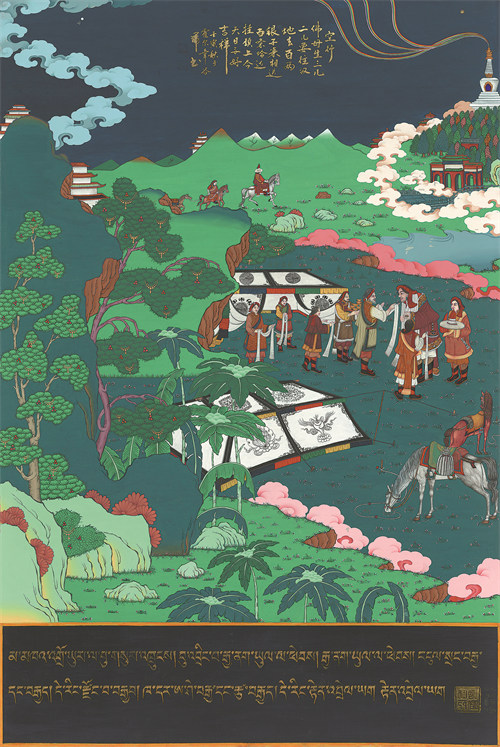
"These local Langkajie thangka painters document contemporary history in their own way. When I view these works, I can sense the emotions within them," says Li.
During the past decade, more than 40 thangka painters from Luhuo — a county with a population of just over 40,000 and altitudes reaching 3,860 meters — have contributed to this ambitious project, producing over 160 works. A significant highlight is the portrayal of solidarity between the Red Army and local residents during the Red Army's six-month stay in 1936, including the formation of the first cavalry division and vegetable-foraging teams. Each of these vivid scenes is brought to life in intricate detail.
Li expresses particular awe at some large-scale works measuring three meters in width."The colors are remarkably fresh, employing extensive light blues and pinks, with many auspicious clouds. These are distinctive features of the Langkajie style," she says.

Presented by Chinaculture Registration Number: 京ICP备13028878号-4
Copyright © Ministry of Culture and Tourism, P.R.China. All rights reserved
Presented by Chinaculture Registration Number: 京ICP备13028878号-4
Copyright © Ministry of Culture and Tourism, P.R.China. All rights reserved







 京公网安备 11010502035176号