









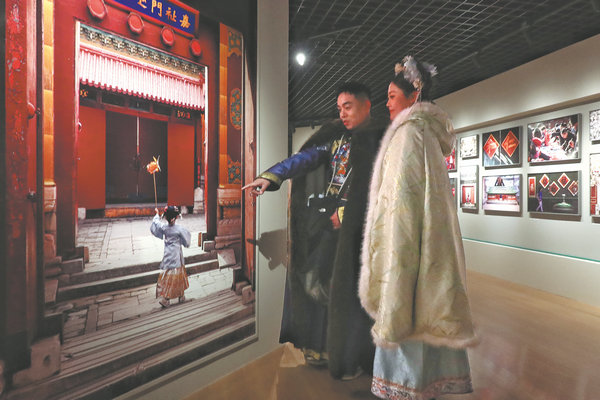
Stepping into the Jiale Hall of the Prince Kung's Palace Museum, visitors are immediately met by two monumental photographs positioned opposite one another.
On the left, a view of the Forbidden City's central axis unfolds under the crisp golden light of a winter morning. The ancient site's Hall of Supreme Harmony, standing solemnly atop its three-tiered marble terrace, commands a sense of absolute majesty defined by "ritual order".
On the right, Prince Kung's Palace's "Bat Pond" rests under a soft blanket of snow. Meandering paths and sculpted rocks trace a landscape of quiet intimacy and conjure up a vivid scroll of "aesthetics of living".
The symmetrical display of the two photographs serves as the threshold into Flourishing Times, New Beginnings: A Visual Journey from Cultural Heritage to Enriched Life, an exhibition that opened in late November.
Jointly hosted by the Palace Museum and the Prince Kung's Palace Museum, the exhibition was staged simultaneously in the Palace of Prolonging Happiness at the Forbidden City and the Jiale Hall at the Prince Kung's Palace Museum.
It features over 200 photographs selected from the two institutions' in-house photographers, forming a richly layered visual landscape that goes beyond mere documentation into interpretation and storytelling.
"This is the visual core of the exhibition — the starting point of the concept of 'gazing at each other'," explains Guan Xin, the exhibition's curator and a photographer with the Prince Kung's Palace Museum.
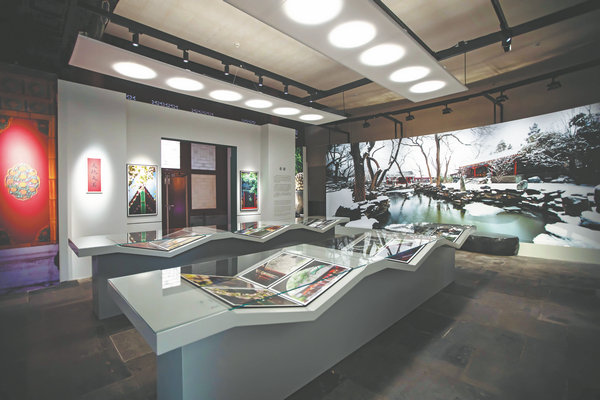
"The strength of the Forbidden City image lies in its extraordinary geometry and centrality — a top-down declaration of order. In contrast, Prince Kung's Palace embodies subtlety, concealment and revelation, and the experience of 'strolling within' that the viewer can imagine," Guan adds.
This juxtaposition creates a unique visual tension. One site represents the state; the other, the home. One is formal and structured; the other, natural and fluid.
"The deeper meaning of 'gazing at each other' lies in the exchange of perspectives," Guan notes, as she pauses before a photograph featuring a little girl at a gate of the Forbidden City. Dressed in traditional autumn clothing and holding a carp-shaped lantern, the child stands with her back to the viewer, gazing upward at the centuries-old gate towering above her.
"I took this photo," Guan recalls.
"That day at the Palace Museum, I came across this little girl during a photo shoot. Her face is unseen, both to protect her privacy and to leave infinite room for imagination. She represents how people today connect emotionally with these ancient architectural spaces," she explains.
This exchange of perspectives also sparked artistic renewal for the photographers.
Guan gestures toward another image, this one of the Belvedere of Embodying Benevolence, taken by a Palace Museum photographer. Fast-moving clouds sweep overhead, while a break in the heavy sky sends down a beam of unexpected light.
"This composition isn't 'perfect' in a traditional sense — not every eave is fully captured. But we were all impressed by its powerful visual impact from the transcendent play of light and clouds," Guan admits.
"This kind of 'gaze' breaks the creative routine followed by those of us who work at the same site year after year. It's both a challenge and an inspiration," she adds.

Presented by Chinaculture Registration Number: 京ICP备13028878号-4
Copyright © Ministry of Culture and Tourism, P.R.China. All rights reserved
Presented by Chinaculture Registration Number: 京ICP备13028878号-4
Copyright © Ministry of Culture and Tourism, P.R.China. All rights reserved







 京公网安备 11010502035176号