
 |
|
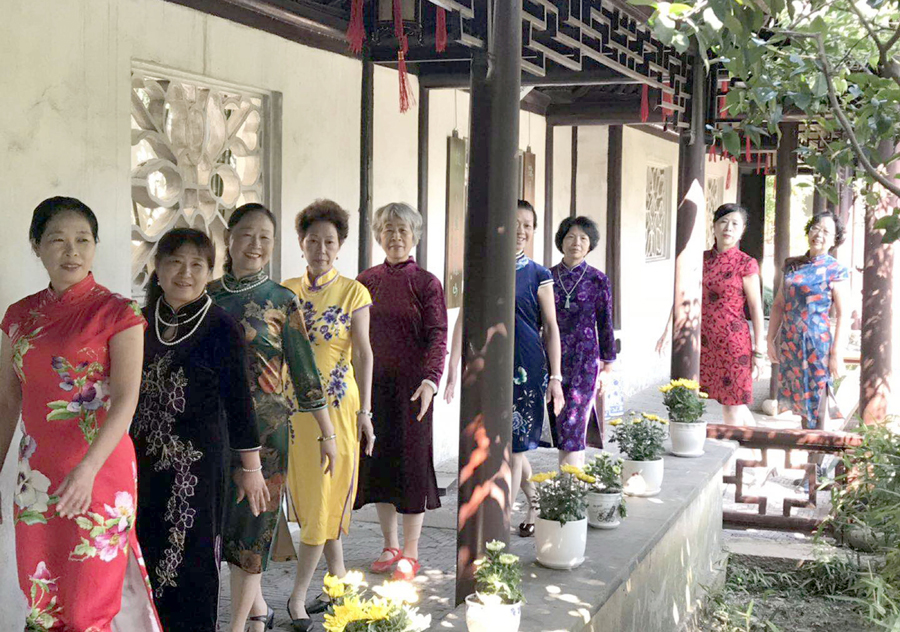
Nine elderly qipao lovers from Suzhou, Jiangsu province come to the Garden of Cultivation for a qipao walk show on Oct 11. They displayed the charm of traditional Chinese costumes in classical gardens and welcomed the upcoming Double Ninth Festival. [Photo by Wang Jiankang/Asianewsphoto] |
Enjoying chrysanthemum flowers
Chrysanthemum originated in China and was recorded in some Chinese books as early as the 5th century BC. The flower was introduced as imperial flower to Japan during the Tang Dynasty. Then it was introduced to Britain in the 12th century, to the continent of Europe in the 17th century and to the US in the 19th century. Also known as "yellow flower", chrysanthemum is of varied species in the composite family. Though its florescence lasts long, this perennial herb usually begins to bloom in the 9th lunar month, lending a festive flavor to the Double Ninth Day. That's why the month is also referred to as "the month of chrysanthemum".
The flower was favored by poets through the ages, because it is one of the only flowers that bloom in late autumn. It is said that Tao Yuanming, a famous poet of the Jin Dynasty, grew many species of chrysanthemum while he lived as hermit, and the flower, when in full bloom, drew many of Tao's relatives and friends. Huang Chao, leader of the peasant uprising in the Tang Dynasty, wrote many poems about chrysanthemum, which were compiled into an anthology of chrysanthemum and are often quoted even now. Du Fu, a great Tang Dynasty poet, wrote more than ten poems singing the praises of the flower.
Chinese folks were fond of enjoying chrysanthemum on the Double Ninth Day long before. Chrysanthemum blossoms in the ninth lunar month have the beautiful name of "flower of longevity". The custom of wearing chrysanthemum appeared in the Tang Dynasty and was very popular throughout the time afterwards. The entrances of some taverns in the Song Dynasty (960-1279) were decorated with the flowers on the day, which was supposed to incite customers' desire for wine. Chrysanthemum displays were usually held immediately after the day in some regions of China in the Qing Dynasty. People in Beijing began to stick chrysanthemums on doors and windows to "get rid of the bad luck and bring in the good ones", which is an alteration of the custom of wearing chrysanthemum on people's heads. At these displays people might enjoy chrysanthemum flowers, take part in poem-composing competitions or watch painters drawing chrysanthemum flowers. The display was often lively with a sea of visitors.
Eating Double Ninth cake
Double Ninth cake is also known as "chrysanthemum cake" or "flower cake". It dates back to the Zhou Dynasty (the 11th century – 256 BC). It is said that the cake was originally prepared after autumn harvests for farmers to have a taste of what was just in season, and it gradually became the cake for people to eat on the Double Ninth Day.
The cake was usually made of glutinous rice flour, millet flour or bean flour. In the Tang Dynasty, its surface was usually planted with a small pennant of multi-colored paper and bore at its center the Chinese character "ling" (order). The Double Ninth cake in the Song Dynasty was usually made with great care a few days before the Double Ninth Day, its surface covered with colored pennants and inlaid with Chinese chestnuts, ginkgo seeds, pine nut kernels and pomegranate seeds.
It was a nice festive present for relatives or friends. In the Ming Dynasty, imperial families customarily began to eat the cake early on the first day of the 9th lunar month to mark the festival, and the common people usually enjoyed it with their married daughters, which was basin-sized and covered with two or three layers of jujubes. The cake in the Qing Dynasty was made like a 9-storied pagoda, which was topped with two sheep images made of dough. The cakewas called Chong Yang Gao in Chinese, which means Double Ninth cake as "Chong" means double, "Yang" dichotomously suggests nine and sheep, and "Gao" means cake. Also, because "Gao" (cake) shares the pronunciation with "Gao" (high, tall), people hope to get a higher position in life by having Gao on the Double Ninth Day.

Presented by Chinadaily.com.cn Registration Number: 10023870-7 京ICP备13028878号-4
Copyright © Ministry of Culture and Tourism, P.R.China. All rights reserved







 京公网安备 11010502035176号