
 |
|
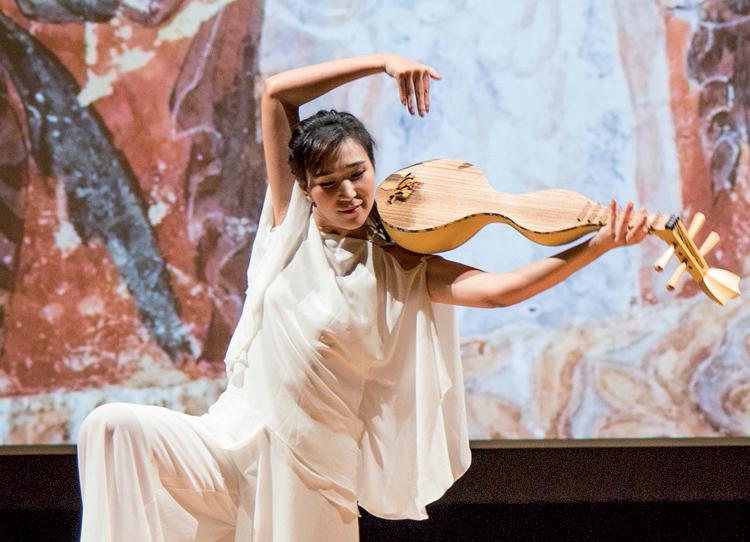
Pipa soloist Shi Wenqing plays Reversed Pipa, part of Tan Dun's new work Buddhist Passion. MAY ZHOU / CHINA DAILY |
There are a lot of stories associated with the caves. Some caves were sealed off from the inside — people closed themselves with the paintings to pray forever, said Tan.
He encountered human bones, sutra music scrolls and gazed upon countless murals. He felt that those people were still praying and playing in the caves.
"They live a long life," he said. "When I was in those caves I realized that those people can still talk to me, I can still exchange ideas with those treasures."
Inspired, he spent two years traveling to national libraries in France, Great Britain and China to locate and research musical manuscripts from the Dunhuang Library Cave. Through slides and videos, he offered a glimpse of his journey.
In Paris, he was shown 25 Dunhuang music scrolls from more than 1,000 years ago. One scroll was titled "Changsha Girl". Being a Hunan native himself, Tan decided to make Changsha Beauty the first piece in his oratorio.
In the Silk Road capital city of Quanzhou, Tan discovered musical instruments depicted in Mogao cave murals and the ancient sounds came to life. One family specialized in making pipas generation after generation for more than 1,000 years. Sometimes one instrument could take more than a year to make.
Also in Quanzhou, Tan discovered another family with deep musical roots — the skill of foot drumming had been passed down in the family for 15 generations.
During his research, Tan gathered about 15 instruments he found in the paintings and incorporated them into his new composition.
Buddhist Passion has been performed in Germany, Australia and Hong Kong since May. The US premiere is set in February next year in Los Angeles.
Contact the writer at mayzhou@chinadailyusa.com

Presented by Chinadaily.com.cn Registration Number: 10023870-7 京ICP备13028878号-4
Copyright © Ministry of Culture and Tourism, P.R.China. All rights reserved






 京公网安备 11010502035176号