









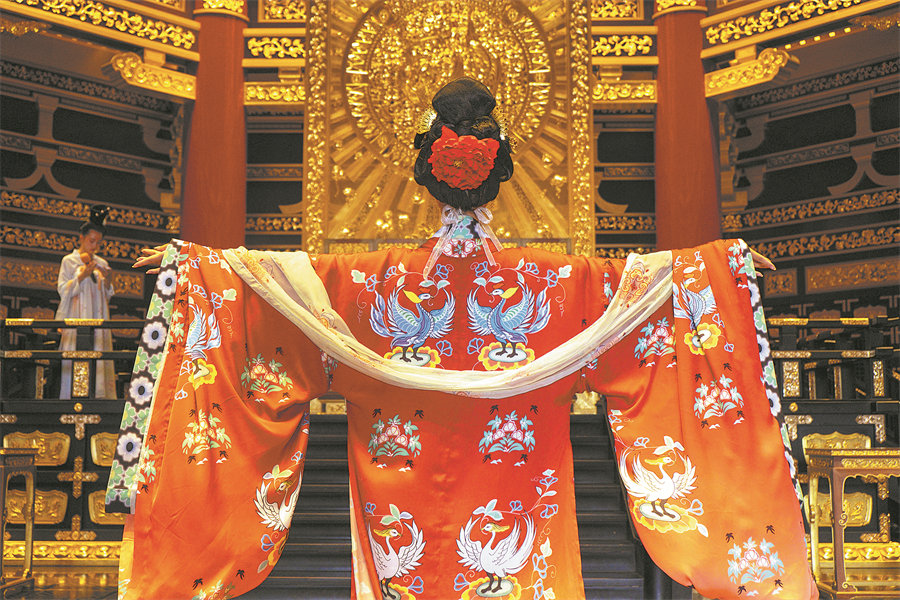
A flourishing city
My next stop in time was Luoyang during the Sui (581-618) and Tang (618-907) dynasties, a significant period in the city's history. In 605,Emperor Yang of the Sui Dynasty ordered the construction of Luoyang as the Sui's eastern capital. He also launched the building of the Grand Canal, with Luoyang serving as a key transportation hub.
This network enabled the transportation of grain from the southern regions around the lower reaches of the Yangtze River to Luoyang, which housed two of the Sui's largest granaries, Hanjia and Huiluo. Thus, Luoyang grew in prominence.
The city further flourished under Empress Wu Zetian. After succeeding to the throne — defying the tradition that only men could rule — she sought to distance herself from the Tang royal family, based in Chang'an (present-day Xi'an, Shaanxi province) and establish a new political order. She chose Luoyang as her capital city and called it the "Divine Capital".
Under her rule, a central axis, an ensemble of palaces, ceremonial and public buildings, roads and other structures gradually took shape.

Presented by Chinaculture Registration Number: 京ICP备13028878号-4
Copyright © Ministry of Culture and Tourism, P.R.China. All rights reserved
Presented by Chinaculture Registration Number: 京ICP备13028878号-4
Copyright © Ministry of Culture and Tourism, P.R.China. All rights reserved







 京公网安备 11010502035176号