
 |
|
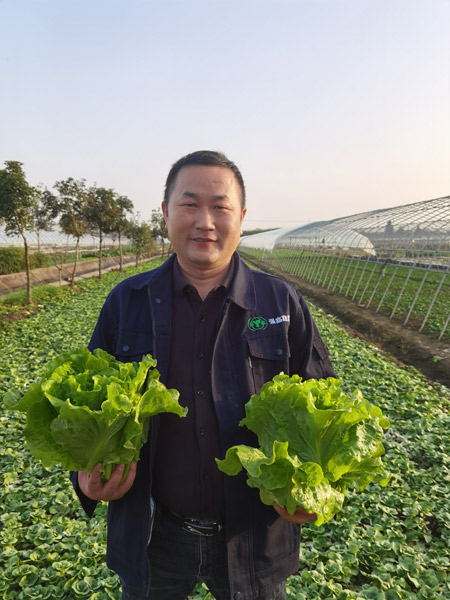
Li collects vegetables from a farm in Dongxihu district in Wuhan. [Photo provided to China Daily] |
Modern agriculture
Wang Shengli, 61, a farmer in Dongxihu district, used to sell his vegetables to local markets by himself.
He and his wife take care of 0.64-hectare of land, growing water spinach, red amaranth and cabbage.
After collecting vegetables from the field, he would ride 12 kilometers on his tricycle with around 200 kilograms of produce to the market, sometimes even as far as 30 km.
"I left at 5 pm and would only return when all the vegetables were sold. Sometimes I had to stay overnight at the market to wait," Wang recalls. "It was quite dangerous to ride the tricycle at night. There have been many accidents that have happened to other farmers."
Wang says there were only a few days in a year that his vegetables could be sold for a good price. Sometimes, when it was harvest time for the vegetables, the price could be quite low and in the end, he would have to leave the vegetables to rot.
"When I rode back home the next morning, I would have to go straight to work on the farm. It was exhausting," Wang says.
Wang joined Qiangxin Vegetable Production and Marketing Cooperative in 2011. Since then, all he has had to do is focus on planting his vegetables and leaving the sales work to the cooperative.
"Now each day after working the land, I can come back home and rest, and I can take better care of my vegetables," Wang says.
Since Li started contracted farming with Hema in 2018, Wang has been following Li's orders. "Li tells us how many kilograms of each vegetable will be collected and when, and we plant accordingly," Wang explains.
"Before joining the cooperative, as my wife and I have to raise our child, we would not have much money left at the end of each year. Now we can save around 100,000 yuan each year and we are living a fairly comfortable life," Wang says.
Currently, Li works with 56 farmers with over 133 hectares of purple bok choy and 67 hectares of cabbage. He plans to cooperate with more farmers out of Wuhan.
Li says the cooperative has set a standard for the farmers' crops so that he can ensure the quality of the vegetables he provides to Hema and other markets.
According to Li, the cooperative also collaborates with agricultural researchers, chemical fertilizer and pesticide suppliers to provide scientific instruction and low-priced products to its farmers.
In 2018, Li took a plane for the first time-he took his lotus stalk to Shanghai for a business trip. "Our lotus stalk has not been sold outside of Hubei before that, because it expires very quickly," he explains.
After communicating with Hema, thanks to their logistics, Li's lotus stalk is sold on Hema's stores in over 10 cities across China including Shanghai, Beijing, Hangzhou, Nanjing, Shenzhen, Guangzhou and Xi'an.
"From the farm to the customers' dining table takes less than 40 hours, which makes it possible for our lotus root to be delivered to more places outside of Hubei.
"I hope to bring other Hubei delicacies to more places by plane," he says.
Li also communicates with local canteens to sell them the vegetables that don't make it to supermarket shelves. "These are also good vegetables that the farmers took the effort to plant. I don't want any of them to be wasted," Li says.
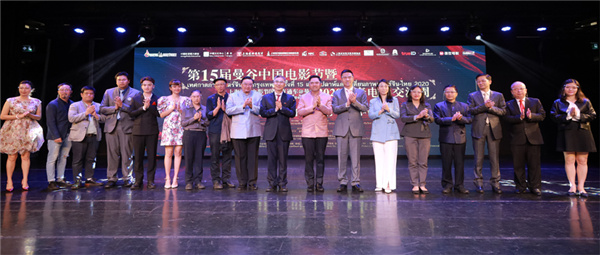 |
The 15th Chinese Film Festival in Bangkok and the 2020 China-Thailand Film Exchange Week opens at the China Cultural Center in Bangkok on Oct 25, 2020. [Photo provided to Chinaculture.org] |
On Oct 25, the opening ceremony of the 15th Chinese Film Festival in Bangkok and the 2020 China-Thailand Film Exchange Week was held at the China Cultural Center in Bangkok. The event was hosted by the China Cultural Center in Bangkok and received strong support from the Chinese Embassy in Thailand and the Thai Ministry of Culture.
The COVID-19 pandemic doesn't impede the enthusiasm for cultural exchange between China and Thailand. This film festival uses live broadcast to present the opening ceremony and host the "China-Thailand Film Exchange and Cooperation Online Seminar". During the film festival, audiences can use the online platform of the China Cultural Center in Bangkok to watch films online, which greatly increases the global reach of the festival.
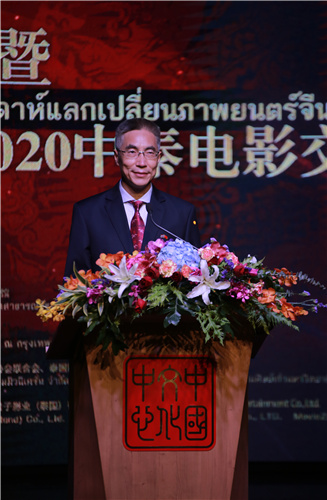 |
Gu Hongxing, director of the China Cultural Center in Bangkok and China Tourism Office in Bangkok, speaks at the opening ceremony. [Photo provided to Chinaculture.org] |
Gu Hongxing, director of Bangkok's China Cultural Center and China Tourism Office, said film can not only introduce one's national culture, but also reflect unique social landscapes. Film has become an important part of cultural exchange between countries and enhance mutual understanding among people around the world.
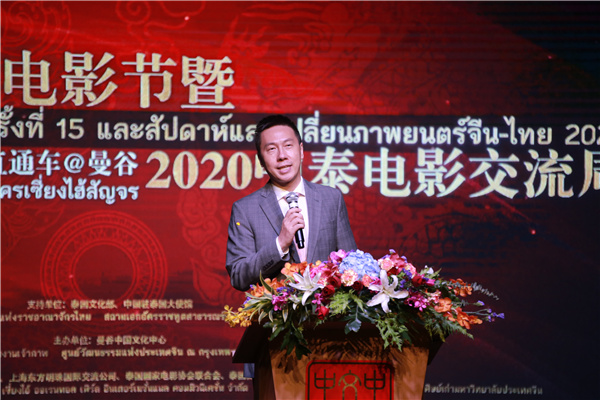 |
Yang Xin, Chargé d'affaires of the Chinese Embassy in Thailand, speaks at the opening ceremony. [Photo provided to Chinaculture.org] |
Yang Xin, Chargé d'affaires of the Chinese Embassy in Thailand, said since the establishment of diplomatic relations between China and Thailand 45 years ago, the mutual trust between the two countries has continued to deepen, economic and trade cooperation has expanded, cultural exchanges have become closer, and all-around cooperation has achieved fruitful results. Both China and Thailand have a vast film market. As a traditional project of cultural exchanges between China and Thailand, the Bangkok Chinese Film Festival has laid a solid foundation for film cooperation between the two countries for 15 years and will add new drive to the promotion of cultural exchanges and cooperation between China and Thailand.
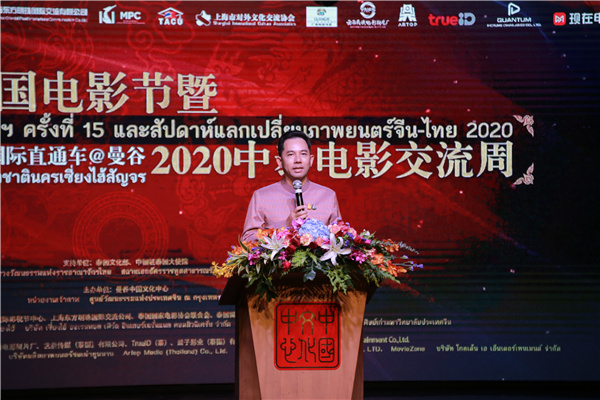 |
Itthiphol Kunplome, Thailand's minister of culture, speaks at the opening ceremony. [Photo provided to Chinaculture.org] |
Thailand's Minister of Culture Itthiphol Kunplome said in his speech the governments and people of Thailand and China have been in constant exchange. Cooperation in various fields has developed steadily, and the film festival is another important event to further promote cultural exchanges between the two countries. The people of the two countries can promote their understanding of the cultures of both sides through films, and promote friendly relations and cooperation in other perspectives.

Presented by Chinadaily.com.cn Registration Number: 10023870-7 京ICP备13028878号-4
Copyright © Ministry of Culture and Tourism, P.R.China. All rights reserved










 京公网安备 11010502035176号