
 |
|
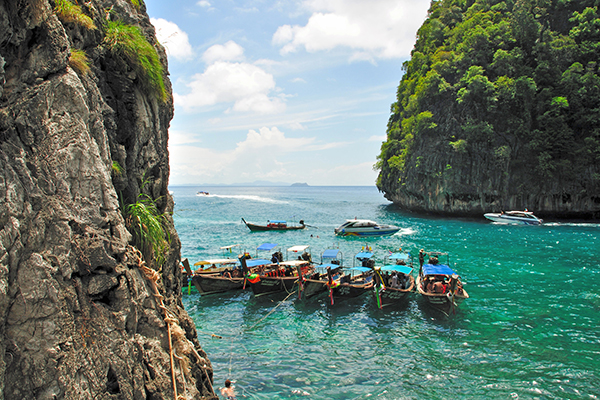
A beautiful seaside view of Phuket in Thailand. Seaside vacations have become a top choice for more Chinese travelers, as they are no longer satisfied with hurried sightseeing and seek a leisurely experience. [Photo provided to China Daily] |
These islands received 98.36 million travelers and generated an added value of 89.7 billion yuan ($13.02 billion) from tourism in 2017, said Mu Xiaofei, a researcher with Shenzhen-based Qianzhan Industry Research Institute.
Investment in island tourism has kept increasing and with supportive policies, improving infrastructure and competitive pricing, this sector has strong growth potential, Mu says.
The policies include the national 13th Five-Year Plan (2016-20), which calls for innovation in market-oriented distribution of resources related to sea and islands. There are also 13th Five-Year Plan policies for the tourism sector, which encourages investment in island tourism, and policies for turning Pingtan in Fujian province and Hainan into international tourist destinations.
Added-value from island tourism in the country is on track for an average 20 percent-plus annual growth to stand at about 220 billion yuan in 2023, Mu says.
Yu Yong from Shenzhen, however, plans to travel to Bohol Island in the Philippines in January. He prefers a Southeast Asian island for his vacation, because of the availability of flights from his city, the well-established facilities and management of the resorts there and that it is a longer-distance retreat from his daily life.
Though they have competitive natural beauty, many Chinese islands lag behind internationally famous foreign islands in areas like transport, hotels, entertainment, services, awareness among consumers and experience in activities, Mu adds.
The inhabited islands in China, for which local governments hold the responsibility, have undergone rapid development, Lin Dong, founder of China Private Islands Alliance, says.
The uninhabited islands, which are managed by oceanic administrations, and came under more stringent protection since late 2009, should pursue a path of specialty tourism, Lin says.
Most of the islands in China are located in subtropical and temperate zones, which makes tourism there more seasonal and return on related investment slower.
Lin suggests more detailed and specific government policies in developing the islands be formulated and that more technology be used, such as for the desalination of sea water and power generation using solar, wind or tidal energy. Island tourism planning and design companies are also needed in this sector, he says.
Island tourism holds substantial potential in China, but - with the exception of islands in Hainan - the present facilities need to be upgraded and the sophisticated planning necessary for the islands has yet to be developed, Huang Huang, a researcher with China Tourism Academy, says.

Presented by Chinadaily.com.cn Registration Number: 10023870-7 京ICP备13028878号-4
Copyright © Ministry of Culture and Tourism, P.R.China. All rights reserved














 京公网安备 11010502035176号