
 |
|
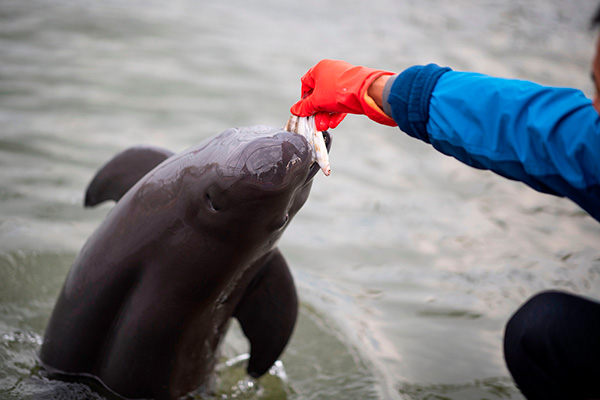
A Yangtze finless porpoise is fed at the Tianezhou national reserve in Shishou, Hubei province, in November. [PHOTO PROVIDED TO CHINA DAILY] |
But researchers see signs of hope.
Porpoise numbers fell by nearly half from 2006 to 2012 to an estimated 1,040.
But the rate of decline has slowed markedly since then, suggesting that conservation may be making a dent.
A central component of the rescue effort is the introduction of porpoises to several conservation areas off the busy river, where researchers say numbers have actually been increasing.
Encouraging signs
Around 30 to 40 porpoises were brought to the Tianezhou Oxbow Nature Reserve in central China's Hubei province-a curving lake linked to the Yangtze by a stream-at the beginning of the 1990s. There are now around 80.
"We found out that the animals can not only survive, but also reproduce naturally and successfully at Tianezhou," says Wang Ding, 60, a porpoise expert with the Chinese Academy of Sciences.
"That's very encouraging."
Researchers also credit official clampdowns on polluting activities and overfishing, artificial reproduction projects, and growing environmental awareness among China's emerging middle class.
"The voice and supervision of the public have played an important role," says Zhang Xinqiao, the species' project manager at the World Wide Fund for Nature.
Chinese officials are keen to avoid a repeat of the baiji, or Yangtze dolphin-the river's only other aquatic mammal, which since 2007 has been considered "functionally extinct"-which was a huge conservation setback for China.
Losing the "smiling angel" would be a further tragedy, conservationists say.
One of the world's few freshwater porpoise subspecies, it is considered a natural barometer of the overall health of China's most important river.
'River pig'
The finless porpoise is mentioned in ancient Chinese poems and has been considered a harbinger of rain.
Some locals call it the "river pig" for its plump body and rounded head.
Adults can reach two meters long.
Since China reopened to the world four decades ago, living standards have soared, but so have air and water pollution.
But in January 2016, President Xi Jinping called for a river protection push. Steps have included curbs on development, stricter fishing rules and other protection projects.
Later that year, a formal porpoise action plan was launched, including increased relocations away from the river, more reserve sites and research on artificial breeding.
The Tianezhou reserve, established in 1992, claims to be the world's first and only example of cetaceans-which include dolphins and porpoises-surviving and reproducing after relocation.
Local fishermen near the lake were encouraged to change professions and Wang Hesong, 46, became a patrolman at the reserve.
"Look over there, a mother and a baby," Wang says, as his pilot cut their patrol boat's engine at the sight of two arched backs breaking the lake's silvery surface.

Presented by Chinadaily.com.cn Registration Number: 10023870-7 京ICP备13028878号-4
Copyright © Ministry of Culture and Tourism, P.R.China. All rights reserved













 京公网安备 11010502035176号