
| Search |
 |
|
|
Ethnic Koreans are a group of sportsmanship. Enjoying mass appeal, the see-saw and swing are the favourite traditional folk sports among Korean women.
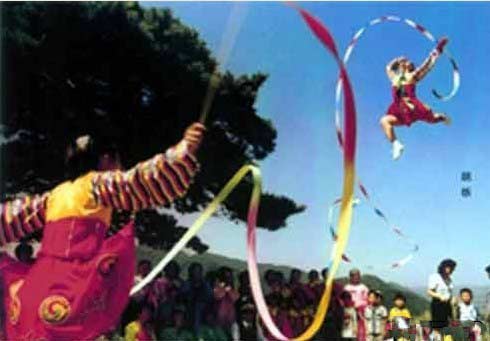
As an athletic event, the see-saw is popular in the Yanbian Korean Autonomous Prefecture, Jilin Province, as well as in other areas inhabited by Chinese citizens of the Korean nationality. Usually, the see-saw competition is held during the Lantern Festival, Dragon Boat Festival, Mid-Autumn Festival as well as other festivals.
Generally, the see-saw is approximately 6 m long, 40 cm wide and 5 cm thick, made mainly of ash, which is hard and flexible. There is a fulcrum. One person stands at each end of the see-saw, springing up in turn and using leverage to thrust her counterpart into the air. As the process continues, participants try to jump higher and higher while performing acrobatics in mid-air. The see-saw event features a variety of acrobatics. An acrobat may jump into the air to land upright on the see-saw, stoopin the air with legs outstretched toland on the see-saw standing upright or throw her chest towards the sky, with arms outstretched and legs wide apart before landing with feet together. This sport requires co-ordination and co-operation between the two acrobats. Sometimes, they yell in turn.
See-saw competitions can be categorized according to height, creativity and skill. In the height category, the longest ankle-to-lever line determines the winner. In the creativity category, properties such as hoops and garlands are used, and the acrobat whose show displays the most standard, difficult and graceful moves is the winner. In recent years, the skill category has been added to the height competition. To win, an acrobat has to deliver the most difficult and graceful moves in the air. Therefore, in addition to courage, the more proficient see-saw acrobat has to outdo a competitor in both creativity and skill. Watching the see-saw competition is always an enjoyable and exciting experience.
As a traditional form of exercise, the see-saw has always been loved by ethnic Koreans. They even believe that "A girl who is not a good see-saw jumper may suffer unnecessarily during the delivery of her baby."
Enjoying a long history, the swing is another favourite event among Chinese women of the Korean nationality. The event is popular in the Yanbian Korean Autonomous Prefecture as well as in other vast rural areas where ethnic Koreans can be found.
Swinging is an event characterized by aesthetics and amplitude. Often, a swing is hung on ropes from a horizontal branch. A bell, drum or ribbon is hung at a high point in the amplitude of the swing. A player has to swing until she reaches the target to win the cheers and praises of the spectators. Whenever a woman swings, people crowd together to watch and cheer. Beautiful dresses sweep back and forth in the breeze, like the wings of the phoenix. The blue sky and green grass create a beautiful backdrop for the swinging back and forth of the Chinese Korean women. Watching from afar, one feels as though they look just like colourful butterflies flying through the sky, presenting a magnificent picture.
Large-scale swinging contests, which are held usually during vacation or certain festivals such as the Dragon Boat Festival, are compelling. Korean women dress in festive costumes to participate in the competitions. The event falls into two categories. One is the height competition, and the other is the endurance competition, in which a performer tries to kick as many times as possible a bell, drum or ribbon. For example, a drum is hung at a great height up. Women swing high into the air to kick the drum to the cheers of the crowd, and the most frequent kicker will become the champion.
Today, swinging is classified officially within the National Traditional Games of Ethnic Minorities of the People's Republic of China. The unique swing of the Yanbian Korean Autonomous Prefecture has found its way into the arena of traditional Chinese ethnic sports.
Source: www.chinese.cn



Why not rent a boyfriend, or girlfriend to please parents during the Spring Festival?


