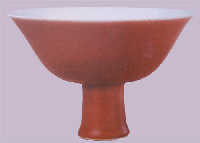
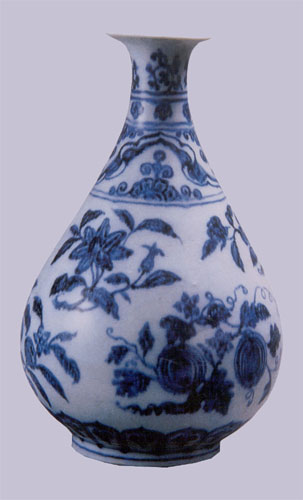
 Jingdezhenin Jiangxi Province was the center of porcelain production in China during the Ming and Qing dynasties. Its kilns have contributed much to the perfection of porcelain and occupy a distinguished place in ceramic art.
China's various dynasties have seen a wealth of wares including the green Yue ware of Yuezhou, Xing white porcelain ware of Xingzhou, Ding ware in Hebei, Ru ware of Ruzhou, the celadon of Longquan in present-day Zhejiang Province, and Jingdezhen ware.
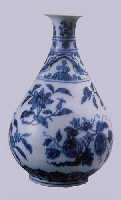 The distinctive style of each is admired in different parts of the world, for Chinese pottery and porcelain went abroad as early as in theHan Dynasty, and was exported in large quantities by the late Tang Dynasty. From North China the wares went westward along the famous "Silk Road"; from the south they were shipped by sea to neighboring Asian countries and then to North Africa and Mediterranean countries. Not until the 15th century did they reach Europe and so have the worldwide impact that provided their brilliant page in the history of world civilization.
Today, every Chinese province or autonomous region turns out ceramics with local features or in the style of the ethnic group of the area. People in the business have inherited and carried forward the fine traditions of the ancient Chinese ceramic art, thereby creating a flourishing situation in pottery and porcelain production.
 Porcelain and Chinese Culture
The charm of Chinese ceramics culture not only lies in its wide range of expressions on social life, nature, culture, customs, philosophy, and various notions, but also in the way of its expression, which is a demonstration of Chinese culture from many angles.
As part of Chinese culture, the history of Chinese ceramics culture is a vivid and vital part of the nation's cultural history.
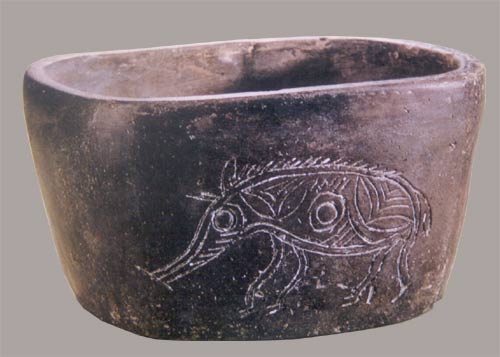
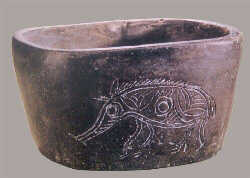 The pottery in the Neolithic (8,000-2,000BC in China) period records the survival will of the ancient people. Pigs, dogs, and cows made of clay signified people's fierce struggle with the environment at the time, from which we can also find the traces of the development and involvement of civilization. Each piece of work vividly revealed a scene of people interacting with the environment.
The terra-cotta warriors and horses inXi'anof Northwest China'sShaanxi Provincereflect the people's philosophy at that time, and vividly record the history in a unique way.










 Email to Friends
 Print
 Save