Porcelain did not come easily. After several thousand years of hard work, the early potters accumulated rich experience in their craft. The earliest porcelain appeared in the slave societies of the Shang and Zhou dynasties.
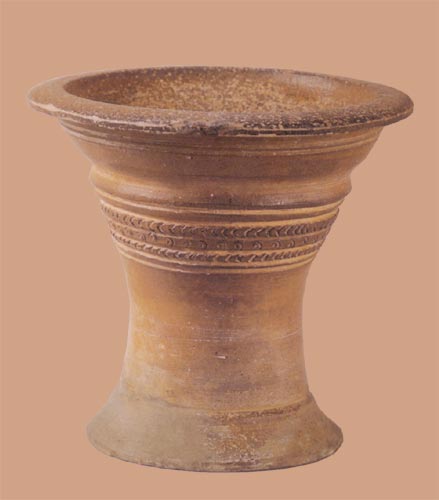
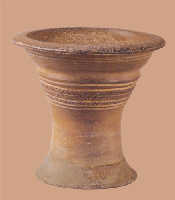 Porcelain as such was, in its initial stage, rudimentary and known now as the proto-celadon from which porcelain developed independently. Whereas pottery is porous and opaque and gives a dull sound when struck, porcelain, non-porous, translucent, and smooth-surfaced, is finer, harder, and closer-knit in texture and gives a metallic sound when struck.
Since the founding of thePeople's Republic of Chinain 1949, a considerable number of Shang and Zhou proto-celadon vessels have been unearthed in many provinces in theHuanghe River(Yellow River) valley and the middle and lower reaches of theYangtze River. These findings are different from earlier pottery made from clay paste, mainly in two aspects.
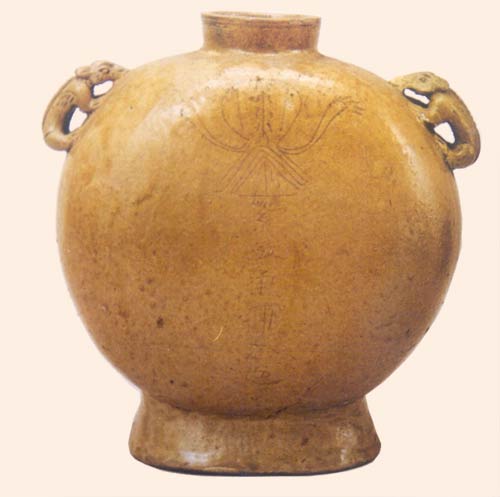
Proto-celadon used white china clay, or kaolin (an infusible white mineral earth produced in the area of Gaoling Village in Fuliang County in East China'sJiangxi Province), which is a fine, pure material suitable for making high quality porcelain.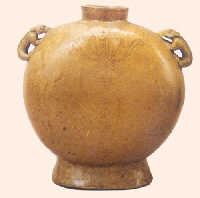
The second difference is that the firing temperature was at least 1,200 degrees Celsius-much higher than for firing pottery, meaning that the distinction between porcelain and pottery lay in the firing of the paste.
These two changes-in the material used and in firing temperature-brought about porcelain. This Shang and Zhou proto-celadon, which basically resembled Song Dynasty (960-1279) celadon, is China's earliest porcelain, dating back to theShang Dynasty, 3,400 or 3,500 years ago.
Porcelain making became steadily popular in theWarring States Period, when it began to step out of its primitive state.
Early in theWestern Han Dynastywhole sets of celadon vessels were manufactured, according to specimens of Western Han vessels that were excavated in Peixian County,Jiangsu Province. Both specimens have been displayed in the Pottery and Porcelain Hall ofBeijing'sPalace Museum. The ewers, steamers, vases, jars, tripods and boxes have a hard paste and are smooth and lustrous compared with earlier wares. The frequent discovery of Han porcelain in archaeological digs indicates that large quantities of the ware were manufactured during the period.










 Email to Friends
 Print
 Save