|
|
|
| |
Representative Painters of Modern Times
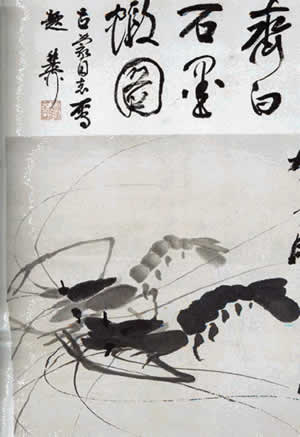
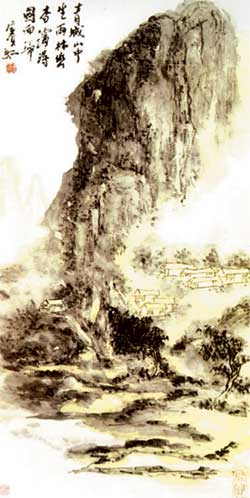
In the modern history of Chinese painting, there was a saying called Bei Qi Nan Huang, referring to the two most outstanding representative painters of this period -- Qi Baishi in the north, famous for his shrimp painting, and Huang Binhong in the south, famous for his landscape painting and theories.
Huang Binhong (1865-1955) was born in Jinhua,ZhejiangProvince. He changed the name of his house into Binhong Cottage and his own name into Binhong in his middle years, because he liked the Binhong Pavilion in his hometown. He took part in a lot of social activities in his youth, and made friends with Tan Sitong, Bo Wenwei, Chen Duxiu and etc. He read many books and gained broad knowledge when he was young, and accomplished much in literature, painting history and painting theory during his life. Before the age of 50, he had copied the works of many famous ancient Chinese landscape painters, which laid his solid traditional Chinese painting foundation. He moved toBeijingin 1937 and worked in theForbidden CityMuseumto appraise the cultural relics. WhenBeijingwas conquered by the Japanese army, he refused to cooperate with the Japanese government and stay at home to study fine arts and write books. In 1944, the Japanese hosted a banquet for the celebration of his eightieth birthday, he refused to present. He moved the bamboo which is grown in the south to his garden, in order to encourage himself and the Chinese people to behave as straight as the bamboo. Huang Binhong is not only a master of painting, but also a great revolutionist and a patriot.
Huang Binhong was influenced by Li Liufang, Cheng Zhengkui and Kun Can in his early years. After 50, he toured around the beautiful mountains and rivers of the country to enrich himself and his paintings. He realized the true essence of art from nature. After the age of 70, Huang began to form his own artistic style and reached a higher painting realm. Many people described Huang Binhong's landscape paintings as dark and moist, showing his subjective impressions of the mountains and rivers. He used deep colors to portray the complicated mountains and rivers, and created a damp effect with a wet brush to draw the grass and trees adorning the mountains. This painting style reveals the attraction and vigor of nature inChina. Huang Binhong produced a great many of works and paintings, he also systematically studied and introduced the paintings of the Xin'an Branch, enriching the record of china's painting history.
 |
|
Qi Baishi (1864-1957) was a famous painter whose life of nearly 100 years spanned two centuries. Qi Baishi was a native of Xiangtan,HunanProvince. His original name was A Zhi. His family was very poor when he was young and he studied only at home with his grandfather for a few years. He then stayed at home to cut firewood, herd cattle and do farm work. At the age of 12, he learned carpentry and then wood carving to help support his family. He accidentally got hold of a copy ofthe Painting Book of theJieziGardenand repeatedly copied the paintings in the book to teach himself basic painting skills. At the age of 27, he began to learn painting, seal cutting, poetry and literature, and made quick progress through diligent study. He matured from a carpenter to a folk painter and finally to a famous artist. Qi Baishi settled inBeijingafter he was 60 and made his living by selling seal cuttings and paintings. He made friends with Mei Lanfang, master of Peking Opera. When they met for the first time, Qi painted grass and worms for Mei, and Mei sangDrunk Concubinefor Qi. Qi Baishi was once elected as the representative of the people's congress, and the president of the Fine Arts Association of China. The Democratic Germany conferred him the Communicative Academician of the Art and Science Academy of Democratic Germany. In 1956 he was awarded the Peace Prize by the United Nations.
Qi Baishi made great accomplishments in painting, calligraphy, seal cutting, poetry and literature. His free-hand flower and bird paintings drew on the painting techniques of Xu Wei, Zhu Da, the Eight Eccentrics of Yangzhou and Wu Changshuo, thus showing his solid cultural foundation. Meanwhile, he fused Chinese farmers' lives and sentiments in his paintings; he drew mice, oil lanterns, abacuses, hoes and rakes in his pictures to reveal the farmers' simple and innocent attributes. He broke away with the traditional Chinese painting notion of the bamboo symbolizing modesty and the orchid indicating delicacy. Qi Baishi had gone through dramatic changes to become a learned painter. His paintings are filled with a happy, vigorous, humorous and self-confident life attitude.
The two masters of art handed down the heritage of the ancestors as well as created new approaches, making a bridge between the past and the future.
|
|
| |
 |
|
|
|
|






 Email to Friends
 Print
Print Save
Save