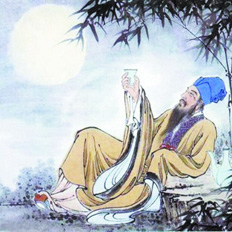
The time-honored Mid-autumn festival boasts a history of thousands of years, which has gradually developed and formed. The ancient emperors used to worship and offer sacrifice to the moon in autumn. Afterwards, noblemen and scholars would admire and appreciate the bright the moon on Mid-autumn festival, expressing their thoughts and feelings.
In the Zhou Dynasty (1066 B.C.-221 B.C.), worshipping the moon on Mid-autumn festival was very popular. Below the moon, big incense burner tables were arranged, on which there were moon cakes, watermelons, apples, red dates, plums, grapes and many other sacrificial offerings. Moon cakes and watermelons were requisite. After the worship, the big round moon cake would be divided into several parts according to the number of family members.
In the Tang Dynasty (618-907 A.D.), appreciating the moon on Mid-autumn festival prevailed and people attached much importance to the worship of the moon. Mid-autumn festival began to become a permanent festival in the Tang Dynasty.
Mid-autumn festival became prosperous in the Song Dynasty (960-1279 A.D.). In the northern Song Dynasty (960-1127 A.D.), on the night of the moon festival, all the people, both old and young, rich and poor, were all well dressed up and burnt incense, praying for the bless of the moon. In the Southern Song Dynasty (1127-1279 A.D.), people gave each other moon cakes as gifts in the symbol of reunion.
In the Ming (1368-1644 A.D.) and Qing dynasties (1644-1911A.D.), the custom of Mid-autumn festival became even more prevailing, such as burning incense, releasing sky lanterns and watching fire dragon dance. In the Ming and Qing dynasties, Mid-autumn festival was as famous as the New Year’s Day and it was also one of the major festivals of China .
There are several explanations on why the festival is so popular and some of the most convincing versions are as follows:
Version One: Nanjing and Mid-autumn Festival
A much-told story about the beginning of the Mid-autumn Festival celebration comes from Niuzhu (a place in ancient Nanjing). As early as 1,600 years ago, Nanjing which was called Jianye served as capital of the Eastern Jin Dynasty. On a Mid-autumn night when Xie Shangyue, the governor of Niuzhu, was boating on a river he met Yuan Hong, a poor, frustrated but gifted scholar who had to earn his living by renting boats. Admiring his ability, Xie made friend with him and Yuan had a rise to fame with the help of Xie. Later on, having heard of the story, many refined scholars from all over the country followed suit to boat in the river, climb up the towers, and watch the moon. Famous poets like Li Bai and Ou Yangzhan were all touched by the story, and then wrote numbers of poems about it. Because of this, the tradition of watching the moon on Mid-Autumn Festival gradually came into being.
We recommend:
Special Coverage:








 Print
Print Save
Save