

On October 10, 1911, the Wuchang Uprising broke out. With one province after another declaring independence from the Qing Dynasty government. As a result, the rule of the Qing Dynasty collapsed, marking an end to the feudal autocratic monarchy of more than 2,000 years and founding the first republic in Chinese history.
To pay tribute to the 100th anniversary of the Chinese Revolution of 1911, with the guidance of Chinese Ministry of Culture, our team designed the photo album which is named "A Century of Change". Through the feature, we will share our insight from our hard work with the readers too.
Brief Introduction to Huanghuagang Park
On April 27,1911(March 29, Lunar year Xinhai), Tongmenghui, a revolutionary Organization, led by Dr. Sun Yat-sen launched an uprising to overthrow the federal Qing dynasty to build a new democratic country, but unfortunately the effort failed .
Seventy-two martyrs were found and buried here in the Huanghua Hillock. The cemetery was begun in 1912 and finished in 1921. (It was later determined that there were 86 martyrs, including 30 who were overseas Chinese.) On the gateway were inscribed four Chinese characters "Hao Qi Chang Chun" by Dr. SunYat-sen, meaning "Eternal Noble Spirit".
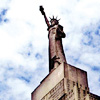
Two-hundred-metre paveway lined with evergreen cypress trees lead to the Martyrs' Tomb. Behind the tomb is a memorial wall made of stones. On the top stands the Statue of Liberty, symbolizing the martyrs' noble spirit of fighting for freedom and democracy.
Near the tomb are pine trees planted by Dr. Sun Yatsen, Lin Shen and Jinlian Wu. That still stand tall and straight. Along the south path dozens of stone tablets are inscribed with epitaphs such as "Soul of Freedom" "Immortal Spirit". Two stone dragon pillars, each more than three meters tall, stand opposite each other on both sides of the path. In addition to the Martyrs' Tomb, there are other revolutionary forerunners' tombs in the park. They are General Dawei Pan. General Zhongyuan Deng, General Xianri Yang, Mr. Ru Feng, Mr. Jianru Shi.
The park also contains Huanghua Well, Huanghua Pavilion, Silent Pond, Square Pond, Octagonal Pavilion, Huanghua gardens, tennis courts and other scenic spots and activities services.
Source from 72martyrs.com.cn
Editor: Shi Liwei
Background's

1、The Preparation of the Revolution
In November 1894, Sun Yat-sen setted up the Xingzhonghui in Honolulu. The next year in February, Sun built the headquarters of Xingzhonghui in Hongkong, and put forward the first guiding principle of the China democratic revolution.
2、The Uprising of the Revolution
The incompetent and corrupt rule of the Qing Dynasty caused extreme anger in Chinese people, finally, In June 1911, the Railway Protection Movement in Sichuan became the trigger of the Chinese Revolution of 1911.
3、The Success and Failure
December 1st, the Qing government signed the armistice with the revolutionary army, and the battle was stopped for three days. This truce is a key turning point that marks the revolution army changed the view from armed struggle to the politics of compromise.
4、Historic
The Chinese Revolution of 1911 is a great bourgeois-democratic revolution, which has far-reaching historic in modern Chinese history.
Historical Remains
 |
 |
|
 |
 |