

On October 10, 1911, the Wuchang Uprising broke out. With one province after another declaring independence from the Qing Dynasty government. As a result, the rule of the Qing Dynasty collapsed, marking an end to the feudal autocratic monarchy of more than 2,000 years and founding the first republic in Chinese history.
To pay tribute to the 100th anniversary of the Chinese Revolution of 1911, with the guidance of Chinese Ministry of Culture, our team designed the photo album which is named "A Century of Change". Through the feature, we will share our insight from our hard work with the readers too.
Mar. 20 1913
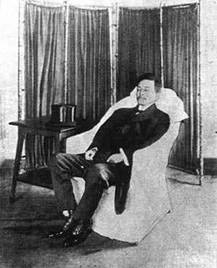 |
Jiaoren after the assassination (Source: http://www.plcsky.com) |
Song Jiaoren was assassinated
Song Jiaoren was shot at the Shanghai Railway Station on March 20, 1913, and died two days later. Yuan Shikai was considered the man most likely behind the assassination.
Born in Taoyuan County, Hunan province, Song Jiaoren (April 5, 1882 – March 22, 1913) was a great forerunner of the Chinese democratic revolution and one of the founders of the Republic of China.
In February 1904, Song helped organize the Hua Xing Hui (a society for the goal of overthrowing the Qing Dynasty) in Changsha City. In 1905, he joined the Tong Meng Hui. In August 1912, the Tong Meng Hui was reorganized into Kuomintang where Song served as its deputy leader.
Translated by Yang Guozhen
Editor: Shi Liwei
Background's

1、The Preparation of the Revolution
In November 1894, Sun Yat-sen setted up the Xingzhonghui in Honolulu. The next year in February, Sun built the headquarters of Xingzhonghui in Hongkong, and put forward the first guiding principle of the China democratic revolution.
2、The Uprising of the Revolution
The incompetent and corrupt rule of the Qing Dynasty caused extreme anger in Chinese people, finally, In June 1911, the Railway Protection Movement in Sichuan became the trigger of the Chinese Revolution of 1911.
3、The Success and Failure
December 1st, the Qing government signed the armistice with the revolutionary army, and the battle was stopped for three days. This truce is a key turning point that marks the revolution army changed the view from armed struggle to the politics of compromise.
4、Historic
The Chinese Revolution of 1911 is a great bourgeois-democratic revolution, which has far-reaching historic in modern Chinese history.
Historical Remains
 |
 |
|
 |
 |