The Miaos mostly reside in the bordering areas of China's southwest provinces. The Miaos have their own language and are mainly engaged in agriculture. Hunting is their sideline. Their arts and crafts, such as the embroidery, brocade, wax printing, and paper cut, are famous home and abroad.
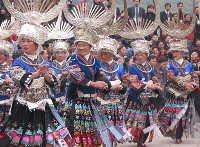 The Miaos used to believe that every life being in the world was spiritualized, so they worship ancestors and the nature. They have many festivals. In addition to the traditional and worship festivals, there are also festivals related to food, such as the Duck Eating Festival, Fresh Tasting Festival, Fish Festival and Tea Collecting Festival, etc. Apart from meat and wine, the seasonal foods are necessarily prepared.
 Miao New Year Festival
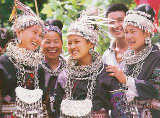 The Miao New Year Festival is commonly celebrated on the first Mao day (the fourth of the twelve Earthly Branches) of lunar January. It lasts 3-5 or 15 days. Prior to the festival, every family prepare abundant foods. Apart from slaying pigs and cattle, they have to prepare sufficient glutinous rice wine. The Year feast is very sumptuous with "seven colors" and "five flavors". They also use the best glutinous rice to make New Year cake. People invite each other to feast and exchange gifts.
 Fish Teasing Festival
The Fish Teasing Festival of the Miaos occurs on June 18 of each lunar year. On the midnight of the day prior to the festival, people stand on the slope and shout to welcome the advent of the fine day. On the morning of the festival, girls go to the brook bank to wash and dress. Around 10:00 a.m., the bird fighting game takes place. The winner will gain the first prize.
At 2:00 o'clock in the afternoon, the Fish Teasing Game begins. It is in fact not fish teasing but man teasing. At the beginning, people from two villages stand in line headed by a group of young men. Each of them holds a small tree with leaves on the top, walk along the riverbank, shouting each step, stopping per ten paces. They keep shouting till they get to the set location of fish teasing. Then, 40 fellows walk out from the group, keep turning in a circle and step on the ground reciting a pithy formula. About half an hour later, a senior citizen steps out of the crowd, and spreads leaves into the river, representing pesticide. Then, two men jump into the river, with waist tied with couch grass, hold each other and welter in water, pretending that they are poisoned by the pesticide and fall into a swoon. They keep crying and weltering. All people are involved in the game. They spring and shout. The clamor echoes in the valley. The game lasts more than one hours till the wallowing fellows writhe to the riverbank.
 Fish Hunting Festival
March 9 of each Chinese lunar calendar is the Fish Hunting Festival of the Miaos residing in Longli, Guiding and Fuquan areas of Guizhou Province. On this day, people go to the riverbank and fork a fish from the river. They set pot and make a fire, and use river water to cook fresh fish. They drink wine and pray for rain, good weather and bumper harvest. There is a tale about this day:
Long ago, the Heaven God had a pretty daughter, smart and intelligent. The Heaven God took her as the apple of his eye. One day, the princess was sick and his father was very anxious. He sent the his subordinates to look for the elixirs, drugs, glossy ganoderma from Kunlun Mountain, ginseng from Changbai Mountain and pearls from the sea. But all these drugs did not work. She was getting worse. Her father was so anxious that he could hardly eat and drink. Later, the Heaven God was informed that there were one hundred kinds of fishes in the river of the human world. He sent deity to fetch the hundred kinds of fishes and decocted. In a couple of days after taking the drug soup, the princess recovered. To thank the fish, the Heaven God gave an order that prohibited people from harming the fishes in rivers and lakes, and he instructed the Rain God to focus raining on the seas, rivers and lakes, without a single drop to human.
At that time, people suffered from drought. The Miaos were very anxious. Hence, they slaughtered pigs and cattle to worship the Heaven for rains. But the Heaven God did not deliver a drop of rain to human. At last, there were no livestock for the sacrifice. On March 9, the villagers caught some carps, chubs, crucians, salmons and giant salamander from the seas, lakes and rivers to take the place of pigs and cattle as offerings. As the Heaven God saw that people in the world killed the fishes for the sake of survival, he cried for three days, and it thundered and rained cats and dogs. Hence, the crops and plants survived.
Till now, the Miaos from Pingpo in Jiuli, Guangming in Guiding City and Xin'an Village in Fuquan will go to the riverbanks to hunt fish on March 9 of each year.
 Drum Worship Festival
It is the largest worship activity of the Miaos, which is held in small scope per 7 years and in large scope per 13 years. It is held on the Yihai Day between lunar October and November. On the occasion, people will slaughter a bull and perform the Lusheng (reed-pipe wind instrument) dance to worship the forebears. They invite friends and relatives for a dine-together to improve relationship and harmony.
 Amatu
Amatu
On the first day of the festival, people will slay chickens to worship the alien ghosts and make by braiding the signs of bamboo strips to prevent its aggression. In the morning, men and women, old and young, all villagers clean up the well, weed and sweep the paths. Then, the "Moba" or the senior of prestige slays a white cock to worship the well and the mountain, for they believe that the water comes from the mountain, and mountains are nourished by forests. Hence, the people there commonly build the well under a tree. At noon, the worship is given to the pagoda of the village, which is built of clay and located in the center of the village. It is the earliest construction of the village. After the worship, every family will set a feast, which is lined down the slope starting from the pagoda and referred to as the feast of the street. All males have to take part in the feast to show their solidarity. After the ceremony, they begin to worship the forest.
The so-called forest is an exuberant wood near the village. The plants in the wood are protected. Women are not allowed to enter the forest. While worshipping the forest, the Moba, the chief of clan, and the senior will beat gongs and worship with blood and three cobbles prepared in advance accompanied by two young men disguised as one male and one female. One cobble is dyed red by the virgin blood of the village girl and are placed at the left side of the tree root, which is referred to as the worship to the dragon (the mountain and the dragon is incorporated; the water will be clean and the wood, exuberant if a dragon exists in the mountain); one cobble is dyed with pig blood, and placed in front of the tree to worship the forest, including the ancestors; the third cobble is dyed with dog blood, and placed at the right side of the tree root to worship the ghost. The disguised man and woman stand for the virginity, standing at both sides of the tree. The three elders chant the incantation to pray for the prosperous offspring, the bumper harvest and safety from the disasters while offering the three cobbles. The worship lasts seven days. It starts from the 3rd day prior to the Dragon day. People stop all farming and fairs. In case the careless enter the village, he or she will be detained and not allowed to exit for seven days.
 Lusheng Party of Baixi
It is also known as the February Lusheng Party Festival. It takes place in mid February of each lunar calendar year, and lasts three days.
The participants of the festival entertainments are the Miaos from Diba, Xinqiao, Shuangjing and Wengxi in the neighborhood, and Gulong, Xinzhou, Chong'an of Huangping County and Panghai of Kaili City. The entertainment of the Lusheng Festival starts from Changshan Village of Baixi. The Lusheng Teams of the surrounding villages led by the senior of prestige go to the Gupa Slope of Changshan Village and blow the Lusheng to pray for the good weather in the current year as well as a bumper harvest.
On the second day, the place of the entertainment is moved to the Lusheng Level Ground in Tunshan Village. Girls dress up and perform Lusheng dance. In addition, there is the game of the thrush match held by the middle-aged and the senior. The horse race is also organized.
 Flower Mountain Festival
It takes place between January 1 to 15 of each lunar calendar year to pray for happiness of the Miaos and bless with safety and prosperity. During the festival, the Miaos get dressed up and go to the large lawn near the village. They play the Lion Lantern Dance, swing, blow bamboo leaves and play the bamboo flute. People erect in the mountain a "flower pole" dyed in red and blue in 12 segments to pray to the god for giving birth to children. Young men and girls riot in dancing and singing and seek their lovers. The entertainment lasts three days, and the Miao villages are filled with animated dance and songs.
On the very day, the erection of the Flower Pole is to precede the activity of the Flower Mountain Festival. The Flower Pole is the icon of the Flower Mountain. It is also the performance tool in the festival. It is made of straight and decorticated fir in several zhang (1 zhang = 3.3 m) high. Afterwards, people plant it in the middle of the Flower Mountain to form the center of the entertainment -- Lusheng ground. The Lusheng players play the Lusheng and dance under the Flower Pole with the contests of climbing pole when playing Lusheng, and climbing pole when playing Lion Dance. There are also programs such as the antiphonal singing, bullfight, horserace, bird match and various martial arts performances, which make the Miaos immersed in great happiness.
The festival not only provides all villagers with the festal gathering, but also the unmarried young people with the chance to seek their lovers. In the mountains south of Yunnan Province, the homemade telephones are installed to enable young men and girls, without knowing each other, communicate with each other or sing through homemade call before date. There is another interesting way of selecting lovers: the young men wander in the crowd. As he found his favorite girl, he will stealthily draw near to her. When he stands at her side, the young man will open the umbrella to cover the girl and sing to observe her reaction. At this moment, the girl keeps silent and skews at the young man. If she finds the young man unsatisfied, she will still keep quiet or refuse by singing. If she likes the man, the girl will look at the young man and sing a sweet song tenderly. As they feel satisfied with each other, the girl will offer her ring to the young man as the keep sack. When the Flower Mountain Festival ends, the spoony girl will follow her lover.
In the Flower Mountain, the most favorable young men are those fellows who climb the Flower Pole while heading down and taking up the Lusheng and pig head. He has to climb up and down keeping playing Lusheng, which can match with the acrobatics. The crowned young man is not only regarded as the hero, but also the icon among the girls. It is said if the young man courts some girl, she will surely fall in love with him.
 Beginning of Autumn Festival
It is a traditional festival of the Miaos. It is also known as Yanu Festival. On the very day, the Miaos in the neighborhood will gather around the fountain pool to hold various entertainments, which is in memory of the hero "Yanu" in the ancient time. The participants of the annual festival reach more than 200,000. A man and a woman dressed in traditional Miao costumes, upholding the corns and paddy, hold the ceremony for the celebration of the bumper harvest under the swing frames; then the dressed-up Miao people begin to play swing, climbing "sword ladder" and perform Lusheng dance. The young men and girls will take chance to seek their lovers. The singers sing songs with partners to greet each other. The scene is full of harmony and passion.
 Sororal Meal Festival
The festival is also known as the Sister Meal Festival. It is the traditional festival of the Miao women in Hainan Province. It takes place on February 15 or March 15 of the Chinese lunar calendar.
On the first day of the festival, the sisters of the village gather to fetch fish in the paddy field for the sororal meal. Afterward, they go to the playground in groups to watch the children games or to take part in the entertainments. In the evening, young men and girls get ready to sing in antiphonal style. The young men from other villages have to win, or they would not be allowed to have the sororal meal. On the second day, the festival reaches the upsurge and become the mass entertainment gathering. The dressed-up girls perform antiphonal songs, and Lusheng dance. They dance by beating drum or watch the bullfighting and horserace. When the young men of other villages are going to leave, the girls will pack the sororal meal (colorful glutinous rice) in handkerchief and put in basket to send to their lovers. According to the local practice, the married women also have to go back her parents' home to celebrate the festival.
 Rat Eating Festival
It is the traditional festival of those Miao people with the surname of Long (dragon). It occurs between 1st and 2nd of the twelfth month of the lunar year.
On the occasion, the men of the Long family working far away and the married young ladies have to hurry back home to worship the ancestor. The rite of the worship is rather simple. They just place the offerings near the kitchen or on the spirit tablet. The young men burn joss sticks and the host offers the food and wine to the spirit of the ancestors praying for the luck in favor of the offspring. It ends up soon. The only special is the offering. The rat meat is indispensable, and the more, the better. If the rat meat is really not available, the glutinous rice cake in the shape of rat could be the substitute. In order to make sufficient preparation, every family starts catching rats after the autumn harvest. If the rats cannot be found around the house, they will go to the field or the mountain to entrap wild rats. If the game is the small rat, they will kill on the spot; if it is a big rat, they will slay and clean up the viscera and bake it for the offering. Hence, the supper of the worship is a feast of rat meat. As all family members get home, it seems to be a New Year festival, which is named by people as the Rat Festival or the Rate Killing Festival.
 Bullfight Festival
There is a large Bullfight Festival in many Miao villages of Yunnan Province. It is the largest festival of the Miaos.
The bullring is commonly set on the grassplot enclosed by the exuberant trees. On the occasion, the dressed-up Miaos from various villages pull the bulls and gather on the bullring. At the beginning, people free all bulls into the bullring. All of sudden, tens of bulls furiously seek the rival. They charge to each other. The loser runs away quickly and the winner chase closely. It is not until the rival escapes from the bullring and disappears in the crowd that the winner will get back and look for the new rival. When all losers from the first ring vanish, there will be a new battle among the winners. The defeated bulls run away again. The gainers of the third round will wrestle till the last couple of fighters remain in the ring. This is the duel of the greatest highlight between two bulls. As they are equal in power, the fight gets more furious. Sometimes, the fight lasts several hours. It is not only the question of bout of power, but also the contest of skill. Both seek the weakness of the opposite and charge at each other. The horns bump, producing earsplitting sound. Sometimes, the duel lasts till the sunset. The final winner proudly stands in the center of the bullring. Its master puts a large flower on its horn and leads it to walk around. The audience feed it the red eggs and food. Many flowers are scattered toward the final winner.
On the evening, people make a need fire on the bullring. Lads play Lusheng while gals dance. The elders narrate the old tales. People feast over night.
 Bull Worship Festival
The Bull Worship Festival is the most ceremonious old custom of the Miaos. This festival is actually to challenge the god rather than to worship the god. This is a test to prove the human's conquering power over the deity. Legend has it that in the remote past, the bull was tameless and ferocious. It had blood red eyes like double copper balls. Its horns were sharp like the sword. The beasts of the mountain were scared of it and escaped at its presence. Hence, it was titled as "Spirit Bull".
One day, the bulls in groups went on the rampage to the village. All villagers were scared. Every family burnt joss sticks and prayed on bent knee for forgiving. However, the bulls walloped in the village and ran down the walls and killed people. Blood spread everywhere in the village and the houses crashed. The chief led villagers to escape from the village and ordered that the one that captured the bull be listed on the hero record of the clan and worshipped by generations. A strong and martial young man named Yanzha showed up and told the chief, "There is never an evil unbeatable under the spearhead of the Miaos. " The chief was surprised and asked: "Dare you fight the 'Spirit Bulls'?" "Yes!" answered the fellow. "Don't you fear them, do you?" "No!" He answered. The chief was very happy. He prized the fellow and awarded him the spear and asked the necromancer to pray for him.
Yanzha, a guy full of courage and skills, chased the crowd of bulls in company of the beating of drums. The bulls, hopping mad, besieged him. Yanzha, shaking the long spear, twisted his body to avoid attack, stabbed with rush. Some bulls were wounded and conflicted to each other. Most bulls escaped from the village. The only left three were two buffaloes, one black and one white, and an unwounded scalper, which made a converging attack to the fellow. Yanzha did not fear at all. He fought even valiantly.
Other young men saw that Yanzha killed and wounded the spirit bulls; they were free of the fear and joined the battle with spears in hands. They killed the scalper and wounded the black one. But the white buffalo attacked Yanzha from the behind. He had no time for hedging. In this critical moment, an arrow shot from afar and hit the nose of the white buffalo. It felt such a great pain that it could not move any more. Yanzha scratched its nose and the others compelled with spears. They pulled the white bull out of the village. At the gate of the village, Yanzha saw Abi, the old arrow shooter of the Miaos, taking a bow in hands. He then understood.
Since then, the bulls have been tamed, and used for plowing. Yanzha vanquished the "Spirit Bulls" and made contributions to the village. According to the order of the chief, people held a singing party for him to celebrate the victory. On the occasion of the celebration, people replayed the scene of bullfight, which was followed by generations and became the actual old custom.
The Bull Worship Festival is commonly held at the time when farming is finished and the garners are full of the cereals. On the occasion, the village chief will ask the necromancer to choose a fine day and extends invitation to all villagers of the Miaos. The host of the ceremony will use the bull skull to worship the Fortune God; then, black, white and yellow bulls, one for each will be taken as the "Spirit Bull". The necromancer will play magic power to drive out the ghost on the "Spirit Bull", so as to safeguard the village, keep human and livestock safe, bring about good weather and longevity.
In three days prior to the Bull Worship Festival, all villagers, friends, relatives, and guests have to prevent from the disasters of the bull ghosts. During the evenings of the three days, hosts, guests, as well as neighbors, will make a need fire, sing and dance to welcome the advent of the ancestors' spirit and share the offerings and incense offered for the Bull Worship Festival.
 Dragon Boat Festival
The dragon is the symbol of the luck and power for the Miaos. From May 24 and 27 of each lunar calendar year, the Miaos and peoples from other ethnic groups in the neighborhood will gather at the Qingshui riverbank of Taijiang County to hold the boating contest for the celebration of the Dragon Boat Festival.
The dragon boat of the Miaos is rather special. It is commonly made of a large fir or phoenix tree. The boat body is around 20m long. The head of boat can rise high above the water and a dragonhead is installed on it. The two bending horns take the shape of the bow and a string hanging banners is drawn between two horns. Behind the horns, there are four pheasant feathers to give a look of portliness. The poop is also over water surface and the grass is inserted on it, which is named "Phoenix Tail".
On the festival day, people are in crowd at the Qingshui riverbank. The dressed-up girls of Miaos gather along the riverbank and watch the contest of boating. Several dragon boats respectively carry 40 strong shipmen dressed in uncolored clothes. There is a drum commander for each boat.
Before the contest, the villagers will offer every dragon boat at presence with chicken, duck, goose and pork. Some gifts are kept on the board, and some hang on the fore. At the noon, with three cannon shoots and cheers, tens of dragon boats cut a feather. The gongs and drums beat to cheer for the contests and pull the festival to upsurge. The winner will be awarded with brocade. After the contest, the horserace, bullfight and bird match will be held. The young men and girls will enjoy antiphonal singing and drum dance, etc. The entertainment will last deep into night.
 Jumping Flower Party
On the occasion, all people of Miaos from the scope of several kilometers away will come to take part in the entertainment. The Bouyeis and Hans will also come to be lookers-on. There are usually over 10,000 people.
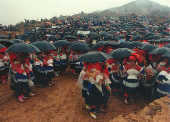 The young men and girls of the Miaos participating in the Jumping Flower Party will all be dressed in new costumes. Whether the young men have Lusheng or not, they have to wear a girdle around the waist; regardless how pretty they are, the girls must have a handkerchief or a strip in hands in order to allow them to "pull sheep" when the party officially begins. To "pull sheep" is slang used in public in courting young men and girls. When the emcee announces the beginning of the party, the young men with Lusheng will strive for stepping in the dance floor and turn around the flower tree. They blow the "Lusheng" while dancing and try to attract a girl by his cheesy dance. When a girl outside the dancing ground gets satisfied with some young man in the place, she will follow him by turning around. If now the possible partner is in the dance floor, the girl will choose among the young men outside. If she likes a young man, she will entrust one of her relatives or friends to send the message to the young man. If the latter agrees, the girl will send him a towel as a gift to show her friendship and make an appointment to be "pull sheep" partner in the official party.
As the young men playing Lusheng walk forward in line, the girls enter the dancing ground that have already localized their partners for the "pull sheep". They walk around the flower tree one passel after another. When they finish one or two rounds, the "pull sheep" starts. Girls tie one end of strips around the waist of the young men they like and hold the other end, and then follow the young men. Young men who are followed by several girls in a fan shape look like a peacock. It is an envious scene. The young men in favor are proud of it. Their friends are proud too. In two or three hours, the emcee announces the end of the game. The girls exert a pull, and the strips come away. The game of the "pull sheep" winds up and the audience starts to empty. However, the young men and girls will continue to take part in the "Zhoushengnian".
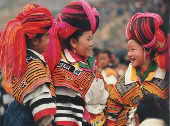 The "Zhoushengnian" is the game of courting between girls and young men excluding the "pull sheep". Girls stand in pair. The young men, also in pair, will play Lusheng in front of the girls. They blow a little while and turn back and walk forward. The girls will follow the young men and walk several rounds if they like, but they will not "pull sheep" and just keep standing if they don't like the young men. If the young men find the girl does not follow, he will stop playing and goes to seek for other girls. But the girls won't disappoint the young men, whether they like the young men or not, they will follow the young men for several rounds. The Zhoushengnian will end up in less than one hour. The partners of "pull sheep" will invite each other for home guest. If there is moonlight in the night, they will play Lusheng dance in partner. In comparison to the Lusheng dance in daytime, this will be even more interesting.
The dance on the Flower Ground of the 2nd and 3rd day is just similar to that of the 1st day. The girls invited their favorite young men to visit their families after lunar January 25. If the young men show up at the invitation, they will become lovers. If the young men break the appointment, the friendship will be interrupted. It is the same case with the young men.
 Vegetable Picking Festival
It is the festival of the Miaos in Guizhou Province. It is called "Woruojie" in the Miao language. The word "Wo" means to pick or collect, "Ruo" means vegetable, and "Jie" is the name of a particular kind of vegetable. The festival is celebrated from March 12 to 14 of the lunar calendar. It lasts two days. On the occasion, women of Miaos go to mountains to collect vegetables for sale, which later gradually evolved to a festal custom. As the Vegetable Picking Festival occurs in spring for plowing and seedling, it also means to greet and welcome the harvest.
The 1st day of the festival is reserved for the entertainments. In the afternoon of March 13, women of the Miaos will dress themselves up in pretty costumes and gather from far and near to the Jumping Flower Ground. Some young women perform Lusheng dance to the accompaniment of the Lusheng melody to show their happiness. Young men ride on strong horses to take part in the festival.
According to the traditional practice, the married women have to go back to their parents' home with gifts to visit parents, brothers and sisters. Upon departure, the mothers will give their daughters a large pack of sticky rice for their husbands' families.
 Datong Year
The Datong Year mostly prevails in the residence area of the Miaos in Guangxi. It usually takes place in January of each lunar calendar year.
The Datong Year has to be held between two villages, which have the relationship of marriage. In addition, it should consider whether the number of the families, manpower and material resources of the counterpart are appropriate. If there is a great disparity, one of the parties will refuse, for they need to slaughter livestock according to the traditional practice. The grade is classified from the highest to the lowest of the buffaloes, scalpers, pigs and sheep.
The Datong Year is commonly proposed by the young men and determined by the village chief. If Village A decides to observe the Datong Year with Village B, it will dispatch a Lusheng team to the lawn of Village B and set off firecrackers, iron cannons and play music to invite the Lusheng team of Village B. The latter will accept and start a contest of Lusheng. Then, the representatives of A will present the red invitation letter to that of B. Agreeing or not, Village B has to give a warm welcome. If the invitation is accepted, Team A will stay one night in Village B to discuss the date and relevant programs of the event.
On the appointed day, the village on invitation will leave only a few people in the village. The other people get dressed up and go to the host village for celebration.
On this day, the host village has built up a colorful gate of the village and placed rice wine at the foot of the gate. Men and women will stand at both sides of the gate. At the sound of the Lusheng from the guest village, the host village will send its Lusheng team to welcome the guests and clear a way to guide the guests up to the front of the gate. At this time, pretty girls will toast the guests with their homemade wine. After drinking the wine of the gate access, the guests will be led by the host village chief and the Lusheng team to the lawn, followed by the villagers. When all people are there, the ceremony of the Caitang will be held. The clamor sounds earsplitting mixed with the firecrackers, homemade iron cannon fire guns, Lusheng as well as laugh and shouts. The host of the village invites the guest Lusheng players and girls to perform Caitang, then the Lusheng players and girls of the host village are engaged in dancing.
When the Caitang finishes, people from the host village start to "capture" the guests. A string of firecrackers have to be set off in front of the guests, who are the target to be "captured". The more guests captured the more they are delighted. The losers often beg the winners of more guests to share with them. The one, who has no share, will ask the team chief to make reasonable judgment trying for the share. If a young man or woman guest is "captured", he or she will be accompanied by the appointed person; in case of a male guest, the partner will be female, and provided the guest is female, the partner will be male. In addition, the partner must look handsome or pretty. On the evening, the guests will be feasted. The fragrant rice wine, preserved meat, fish, duck, goose, birds and fresh meat with mushroom and mushroom soup in hot pot will be served on the table. After the feast, the elder will chat and the young men and girls will sing songs and court each other.
On the 2nd day, the official Caitang begins. After the ceremony, the Lusheng players of both teams and girls enter the ground, the guests preceded by the hosts. Shoulder to shoulder, they play together the Caitang Tune. In case that the host village prepares to slay a buffalo, an elder will pull a big buffalo and turn around in the ground while people riot in dancing and singing. Afterward, the buffalo will be pulled to the shambles. On the very day, the great beef feast takes place on the Lusheng Ground. The hosts and guests raise cups and toast each other to celebrate the event. On the evening, the young men and girls chat in groups with passion and sing in antiphonal style till the daybreak.
On the 3rd day, the guests will depart. Prior to the departure, the hosts and guests will go to the Caitang Lawn and play Lusheng for a while, then say farewell reluctantly.
At parting, the hosts will bundle a buffalo head and a slain fat pig on a bar and ask the guests to carry them back. Seeing off the guests, the host village will fire guns and cannons and send the guests far-off.
 Drum Pulling Festival
It takes place once every 13 years in October of the lunar calendar. There is a nice folk story concerning the origin of the Drum Pulling: The drum was formerly preserved in the Heaven. People in the Heaven and on the earth could freely communicate with each other. Once, the Drum Pulling Festival was celebrated in the Heaven. Yongpeng and his wife went to watch the entertainment of the Drum Pulling in the Heaven at the invitation of his mother's brother. He got from the Heaven a drum. When the drum was beaten, the animals ran away and insects disappeared. People on the earth had a harvest and lived in safety.
Another tale says that the Thunder God battled with Ying and burned out all woods in the world. The mountains were bare. Haoliang took all the trouble and trekked a long way. Finally, he found the fir seeds. From then on, there was green fir forest on Miao Mountain. But he became a tree. In order to thank Haoliang for his contribution, people cut a tree and made a drum, which they took to the village as if Haoliang were back to the village. Men and women, old and young, they were all delighted. Thereupon it became a custom to hold the Drum Pulling Festival every 13 years.
The Miaos in Tongle of Sanjiang will elect in advance the emcee in February to celebrate the Drum Pulling Festival. They cut a large tree, and make a wooden drum. Then they use a large wisteria to penetrate it through drum's center. At the same time, they plant on the mountain a Phoebe nanmu. In the very day of the festival, every family sends a person on the early morning to go to the Drum Pulling Mountain. All bags hang on the tree. After the necromancer finishes incantation, people start grabbing the leaves and put into bags, for the villagers consider that the more leaves, the luckier they will become.
While pulling the drum, a person playing Lusheng leads the way. The young people pull the drum along the slope and the others escort. In the entourage stand many lookers-on and people carrying wine and meat. The invited friends and relatives fasten the rattan and tie it on the nearby trees to make troubles, so that the drum carriers are not able to go through easily. When the drum carriers get home, women wait in the front of the door to welcome them with wine and meat. Every family feasts the guests from other places. At last, the necromancer will write down the names, dates of birth and dates of death on a paper, then put it into the drum. Afterward, he approves to place the drum into the cave. In the evening, people gather together to play Lusheng and riot in singing and dancing.
 April Eighth Festival
The April Eighth Festival is the traditional festival of the Miaos in the southwest of Guizhou Province. It is also known as the Yanu festival.
On this day, the Miaos from the nearby places gather around the fountain pool to hold various entertainments to memorize the hero, Yanu.
The participators of the festival will be more than 200,000. People play Lusheng, dance, sing, swing, climb the sword ladder, play lantern, and lion dance. People are in large crowds and the scene is wonderful.
Legend has it that the ancestor of the Miaos formerly resided in Luogesang (near today's Guiyang City in Guizhou Province). They lived with ample food and clothing. Afterward, a local tyrant coveted this place and robbed them of it. Yanu, the leader of the Miaos led the people to resist the oppression. They always headed off a danger each time they were encircled by the enemies.
In a furious battle, he was fatally slain by the ruler on April 8. Once at the date of his death, the Miaos will go to his tomb near the Fountain Pool to memorize the hero. The custom is observed by generations.
 Guzang Festival
It is the most ancient and spectacular festival of the Miaos in Guizhou Province. Xianglu Mountain is located 15 km from the west of Kaili City in the southeast area of Guizhou Province. It is a famous peak of Miaoling Mountain at an altitude of 1,200 meters, and covers an area of 15 square kilometers. Rocks and cliffs circle the mountain. It is plaint on upper side like a platform and narrow on waist. Xianglu (incense burner) Mountain is named after its appearance in shape of an incense burner.
The term "Chiguzang" is also referred to as "Chiguzang", "Ciniu", "Gusheji" and "Caigujie". It is the most important worship of the Miaos in Guizhou Province. The Miaos believe that the drum made of cowhide is the place where their ancestors used to live, which is considered as the symbol of a kindred family. The "Chiguzang" is a kind of the ritual for the ancestor worshiping passed down from the ancestors for the Miaos in ancient times.
The Chiguzang Festival includes a series of religious rites such as bull fighting, bull-slaughter, making drum of cowhide and worshiping the drum.
The big drum used to worship the ancestors is made of two pieces of cowhides covered on the both sides of a segment of hollowed Phoebe nanmu. There are two kinds of this mysterious big drum: twin-drum and single-drum. The twin drum is made of two similar drums. It is 170 cm long and 30 cm in diameters, respectively, which is inherited from the ancestors. It is preserved in the family with no children after long time of marriage. It is said that to worship the twin-drums will give the family without children the chance of giving birth to a baby and the continuous generation. The single drum is smaller than the twin drum, which is manufactured and applied at the time of the worship. It is manufactured and applied at the time of the worship. After the worship, it will be sent to the cave. It will be never used again and let it rotted with the passage of time.
The rite of the "Guzang" is rather complicated, and consists of a series of great ceremonies, such as receiving the twin drum, worshiping the rotten single drum in the cave, making the new one, bull fighting, bull slaughtering and food offering, etc.
One of the most breathtaking activities is the bull fighting. The big bull will be selected as fighter. The bull chosen is termed as "Crown of the Bull King" and is not allowed to be slain. The victim in the contest is regarded as the hero and is not eligible. It must be buried in grand ceremony. In addition, the stele recording its battle achievements is to be erected on its tomb.
During the bull fighting, the Miaos will treat the passengers and pass-by businessmen as the respected guests; they will invite them to view the bull fighting.
The bull used to sacrifice for the worship has to be fat and strong. It will be decorated. The silver chaplet and embroidered shoes on the horns of the sacrificed bull are designated to worship the female ancestors; the headband and black fabric shoes are prepared for the male ancestors.
When it's getting dark, people set up the altar made of three logs, which are used for the bull slaughtering. The Miaos take out the decoration from the bull and tie it on the spile, then shake the sharp axe to kill the bull. The mysterious rite must be done prior the sunrise and the strangers are not allowed to view. When the day breaks, the bullhead is arranged in order on Xianglu Mountain. The ritual to release souls from purgatory will be presided over by the koradji of the clan. People start singing the old worship song. After the offerings and meat have been sacrificed to the ancestors, the carnival begins. Young men play Lusheng and girls dance. Melody of the songs and Lusheng are in the air. The elders smoke long tobacco pipes. Regardless young and old, female and male, people sing and dance as possible as they could. This entertainment is termed by the Miaos as "Cainiutang" or "Caigu".








 Email to Friends
 Print
Print Save
Save