Traditional juggling act continues to delight young and old, at home and abroad
|
|
|
China's diabolo programs have won many international awards. Zhang Xiuke / for China Daily
|
In the Xuanwu district of Beijing, Wang Huiying stands before a crowd in a red costume, complete with ornaments that glitter in the early morning sun. Wang, 62, is still sprightly enough to perform whirls, splits and jumps to lively music, before ending her repertoire with a one-leg balancing act that generates laud applause.
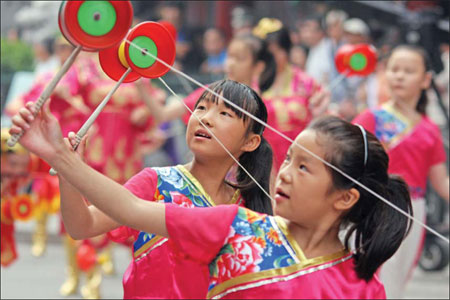
But the retiree has a crucial traditional Chinese prop to help her perform these popular stunts - a diabolo or juggling spool manipulated on strings.
The diabolo, known to have originated from a Chinese yo-yo, was initially made of bamboo. It can be spun, thrown and caught by a string that is tied to two sticks held in the performer's hands.
The whistling sounds the spool makes when it is used symbolizes "the awakening of spring", says Li Shi, a member of the Beijing Folklore Society.
The history of playing the diabolo dates back to about 1,000 years in China and was first created as a pastime for the Chinese nobility.
But during the Ming Dynasty (1368-1644), it gradually passed onto ordinary people and became a beloved folk activity. Men and women, young and old, all enjoyed playing it, Li says.
During the Qing Dynasty (1644-1911), playing and selling diabolos at temple fairs during Spring Festival became a firm tradition. The diabolo also evolved into a popular juggling item on the streets in line with acrobatic acts and performances that delighted local residents and visitors alike.
Li Lianyuan, a 65-year-old certified "national master" of the diabolo, recalls that his grandmother, a great player and also a street vendor in old Beijing, would usually draw viewers' attention by juggling the diabolo.
As more people took up the diabolo, many varieties of making and playing it developed. It can now be recognized in circus-skill toys enjoyed around the world.
Initially, both the spools and the sticks of the Chinese diabolo were made of bamboo, but now they come in different materials such as plastic, wood and rubber.
"The size of the diabolo can be as small as a chess piece, and as large as a truck tire," Li Lianyuan says.
The shape of the diabolo has also changed significantly. Apart from the traditional ones with two discs, there are mono bolos with only one disc.
"They are of various shapes, such as dragons, balls and flowers, which add to the enchanting beauty of any performance," Li Lianyuan says.
The diabolo is easy to learn, the simplest way to practice it being to move both sticks up and down. Practitioners cite the aesthetic charm displayed, soothing sound generated and health benefits derived as major draws.
Hao Delai, a 56-year-old diabolo player who started learning it in 2007, found the activity improved his physical and mental wellbeing.
"Playing the diabolo is good for your eyes, brain and helps you keep balance," Hao says.
"While playing, one has to be concentrated fully. That increases my optimism and gives me peace of mind."
The benefits, popularity and expertise of the diabolo are continuing to spread beyond Chinese shores.








 Print
Print Save
Save