The pond is at the center, basically in the square shape. Bank stones are low and near, with access to and from the pond in a zigzag way. The water surface below the stone extends inward, as if expressing the imagery of waves washing in and Out. Structures close to water also are low and near to the water Surface. A stream bend extends out from the southeast and northwest corners of the pond. These methods of treatment all help broaden the vision of the landscape. As one goes northward from the west wall by the side of the water tower, one finds the height of the corridor increasing gradually. When one climbs up the Yue Dao Fenglai Ting (Pavilion featuring the blowing of the wind in the wake of the appearance of the moon), one feels the full viewing effect at the top of the pavilion. The north of the pavilion leads to the area overgrown with pine and cypress trees and dotted with grotesquely shaped rocks.
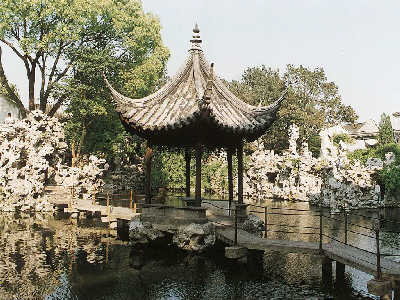
The fairly large Kan Song Du Hua Xuan (seeing pine trees and appreciating the painting room with windows) is north, away from the river bank, and hidden behind pine and cypress trees. The Ji Xu Zhai(concentration of empty rooms) to the east of the small room is a building also far from the pond. To the south of the empty room is a section of empty corridor. The south turn of the corridor is connected to a semi-pavilion called She Ya Shui Ge (shooting at ducks water tower), attached to the west wall of a residence, which faces the Yue Dao Fenglai Pavilion and the Zhuo Ying Water Tower in the shape of the word "ping".
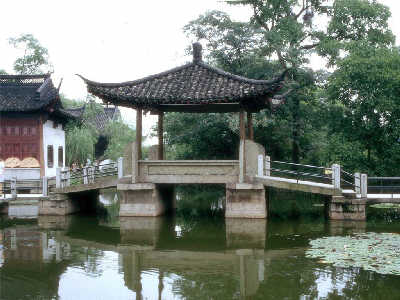
Together, they form a triangular sightseeing spot along the pond, jointly viewing and forming the landscape. The She Ya Shui Ge Semi-Pavilion breaks the dullness of the massive gable, with a collection of rocks piled up on the south side planted with small trees and sparse bamboo. On the tall west wall of the residence courtyard, as the backdrop, two square false ornamental perforated windows are opened. A line of draping eaves is arranged horizontally on the ornamental perforated windows, balancing the composition of the picture and further eliminating the sense of dullness of the west wall of the residence courtyard. From the above two examples, we can perceive the exquisite and minute molding technique of classic gardens south of the Yangtze River.









 Email to Friends
 Print
Print Save
Save