Like many structures in the garden, it makes both seeing and forming views possible. Its size, and that of the Beishan Ting (northern mountain pavilion) on the East Island are very small in order to set off the mountain. The mountain on the west island is big, while the Xuexiang Yunwei Pavilion on it is the main opposite view of the Yuanxiang Hall, so that its size is fairly big. The southern banks of the two islands are supported mainly by stones. Rocks are low, close to the water surface, and their combination is rich. The northern bank is based mainly on earth. It is planted with reeds and willow trees, providing the rustic interest. On the east of the water, there is a Wu Zhu Youju (Chinese parasol tree seclusion-living pavilion). Looking Westward from here across the pond, pavilion and tower, one can see from the treetop the distant BaoenTemplePagoda in Suzhou. When the view of the pagoda is introduced into the garden, it is called a "borrowed view".
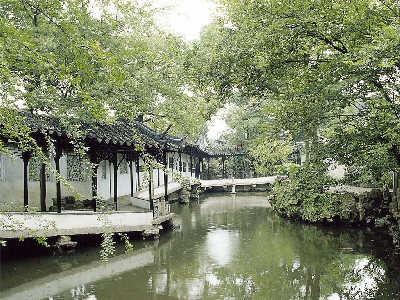
Entering from the semi-Pavilion of the Bieyou Dongtian, one finds the pavilion is also encircled by a meandering river. The east bank is close to the western wall of the central garden. The cross-water vestibule facing north-south is supported by blocks of stones. When one sees the vestibule reflected in the water, one feels that is infinitely secluded and bending. The plane of the vestibule goes along the walls with slight twists and turns, while the vertical also naturally rises and falls. There is a small yard corner between the vestibule and the wall, dotted with severs rocks of grotesque shapes. Several slender bamboo trees and a banana tree are set off on the white plastered wall, making them seem like small bamboo-stone pieces on a painted scroll, and demonstrating unending artistic conception.
The extant outlook of the Wangshi Garden in Suzhou was mostly formed in the 60th year (1795) during the reign of Emperor Gaozong of the Qing Dynasty. Its layout is exquisite, making it a quality example of a small garden in Suzhou. In the main residences of its east neighboring garden, the main doors open to the southeast corner.
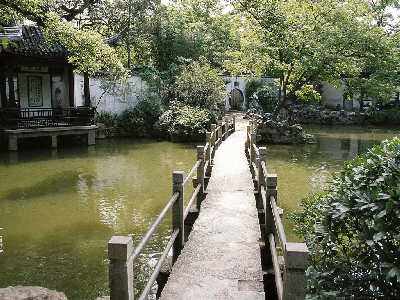
Going westward after entering the gate, one finds a short corridor connected to a hall in the west. On the north of the hall is a rockery which blocks the northward view; only when one goes westward from the vestibule west of the hall in a zigzag way through the small and exquisite Zhuoying Shuige (water tower for living in seclusion), can one find the place flooded with water brightness, giving sudden enlightenment. Like the principle of the entrance to Zhuozheng Garden, it is the customary technique used inChinese gardensto precede a rise with a fall.









 Email to Friends
 Print
Print Save
Save