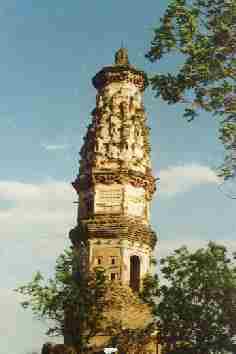
The Ornamental Pagoda in the Guanghui Temple is located on the hillock to the east of Shengmin Street in Zhengding County, Hebei province.
The pagoda is also called Duobao Pagoda. The Guanghui Temple was first built in the Zhenyuan reign (758-804) of the Tang Dynasty (618-907), but the pagoda was not completed until the Jin Dynasty (1115-1234). With the most unconventional style and the most splendid decorations, the pagoda is unique among China's brick pagodas. It is 40.5 meters high, octagonal and has three storeys, and looks like a pavilion. The plane of the first floor is octagonal. With hexagonal one-storeyed small pagodas in four corners, the first storey is just a suite room in the shape of a pavilion. Round arches are opened on the facade of the Ornamental Pagoda and walls of the small pagodas. The plane of the second storey is an octagon. There are four doors in the four primary walls with false lattice window beside them, while only false straight and lattice windows on other four walls. Wooden square blocks inserted between the top of column and crossbeams in the body of the pagoda support the eaves. The third storey becomes a bit smaller, having only one door in the primary wall and false doors in other three sides. Above the third storey is the conoid body of the pagoda decorated with carvings of Buddhas and various animals. These carvings are orderly concentrated and rich in variety. The top part is an octagonal roof and the pagoda top, which is already broken.
The Guanghui Temple thrived in the Ming and Qing dynasties. Emperor Qianlong had visited there many times, worshipping and sightseeing. He even inscribed a horizontal board for it. Today, the Ornamental Pagoda is still standing there, while the Guanghui Temple has gone with the history.




 E-Mail
This Article
E-Mail
This Article  Print
Friendly Format
Print
Friendly Format