 |
 |
 |
 |
 |
 |
|
|
|
|
|
|
| Curiosity > Landscape |
|
|
||||
 E-Mail
This Article E-Mail
This Article  Print
Friendly Format Print
Friendly Format |
||||
|
Northwest China's Cave Dwellings
The Loess Plateau is mainly located in Northwest China and its neighboring regions. Cave dwellings are the result of the Loess Plateau and are generally 100 to 200 meters deep. With little seepage and very sturdy, the loess provides good preconditions for the construction of cave dwellings. The natural conditions of dry weather, little rainfall, cold winters and limited timber also create an opportunity for the development and continuity of cave dwellings, which are warm in the winters, cool in the summers, very economical and require no timber in construction.
There are three kinds of cave dwellings: cliff, ground and hoop.
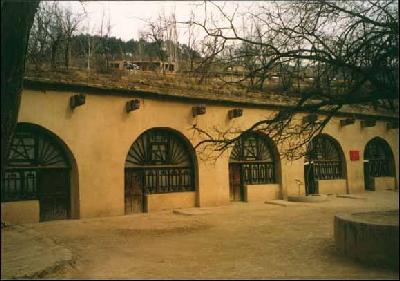
The cliff cave dwelling is an earthen cave dug horizontally along the vertical earthen cliff. Every cave is about three to four meters wide and five to nine meters deep. The straight wall is about two to three meters high. The top of the cave is dug into a semi-circular or slotted-barrel arch. The various caves are connected via tunnels. It is also possible to add other caves, and the upper and lower caves can be linked through passages. Usually, one family unit owns three caves. The center cave is used as the "living room," which includes a stovetop cooking area. The two side caves are the sleeping quarters.
The ground cave dwelling is a square or rectangular pit dug out of the level ground to form a ground yard. A cave is then dug horizontally in the pit walls, which is used mostly in sections lacking a natural precipice. From the ground level one can only see the treetops of the ground yard but not the houses.
The hoop cave dwelling is not a real cave, but a cave-shaped house built of brick or adobe on ground level. The hoop cave dwelling can be a single-storied house or building. If the upper story is also a hoop dwelling, it is called a "dwelling upon a dwelling;" if the upper story is a wooden structured house, it is called a "dwelling upon a house." |
||||
All rights reserved. Reproduction of text for non-commercial purposes is permitted provided that both the source and author are acknowledged and a notifying email is sent to us. |
||||
 |