 The Octagonal Pavilion
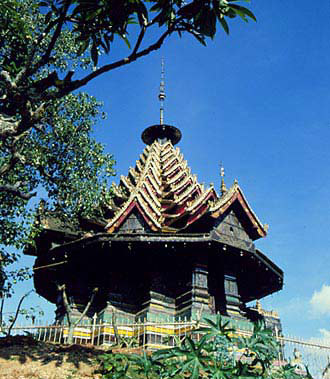
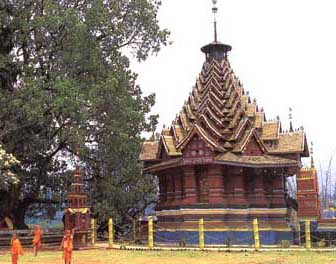
The monastic hall of the Miansi Temple, similar to the Buddhist hall in appearance, is a place used to store Buddhist scripture and hold ihram .Its outward boundary is comparatively closed, and the lower part has a fairly high Sumerian seat. But the monastic hall of JingZhen Temple in MengZhe of Xishuangbanna, a plane polygonal angle cross, is composed of 16 outside angles and 12 inside angles, and ca1led an "octagonalpavilion". Its beautiful shape is the pride of Dai nationality architectural art. The pedestal of the "octagonal pavilion" is laid up with bricks and is quite high. The body of the pavilion is also laid up with bricks. Doors open on all four fronts. The roof is exceptional, composed of many two-slope Chinese overhung gable-end roofs stretching out from every storey and radiating in eight directions. They were laid Up into 10 stories from bottom to top and large to small, forming a complex of silken scale composed of 80 small roofs which are very complicated. The general outline of the roof is of a concave curve: giving a strong sense of movement. Finally, it converges in a laksata plate, then extends upward through a high laksata pole, being fully played up and intensified. The color of the whole pavilion is very bright and beautiful, its shape is delicate and exquisite. The splendid jewelry, under the Sunshine, looks like blossoming lotus, expressing the outstanding molding talent of the Dai architect and the Dai people's ardent feeling for life.
The Buddhist pagoda of Theravada, called Mianta Pagoda, often exists side by side withBuddhist temples, There are also Mianta pagodas constructed independently. The Mianta pagodas are all solidly laid up with bricks, the surface plastered with mortar and coated with white or gold color. The pagoda is composed of four parts: base station, pedestal, the pagoda body and pagoda temple. The change in form and style of the four parts constitutes a variety of images.
The pedestal is a layer of platforms, laid up with bricks or stones, on the rammed earth, which is slightly higher than the ground. It is plane and mostly square. The pedestal plane is also square, composed of one or two layers of Sumerian bases. There are also two-three-layer plain platforms in a staircase shape. The pagoda body is mostly composed of two-four-layer Sumerian bases, with each storey from the bottom becoming smaller than the other. It is plane and mostly polygonal angle cross, but there are also square, hexagonal, round and other shapes. From the pagoda body up is a bending bell-shaped pagoda temple seat, leading to inverted lotus, flower bud, multi-layered dharmamudra wheel and high metal saksata pole with several layers of canopies formed by metal ring sheets strung on it. The canopies are decorated with blazing jewelry or a small pagoda and the like. The temple seat is half of the height of the whole pagoda. Unlike the Han Buddhist pagoda, which takes the tower as the main molding element, the Dai nationality Mianta pagoda looks more like a vertical long-handle bell, which is very forceful and pretty.









 Email to Friends
 Print
Print Save
Save