 Second Shipbuilding Climax -- in Tang and Song Dynasties
 |
|
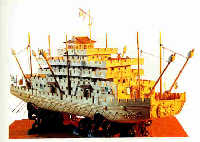
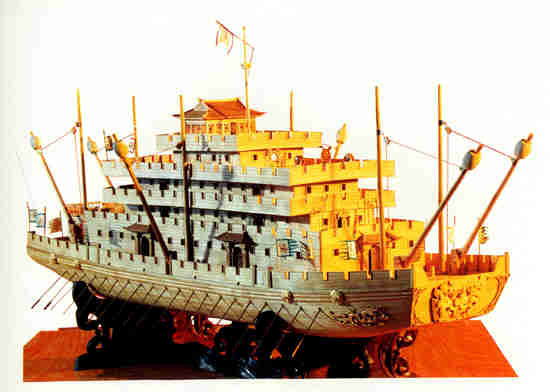
A Model of Wuya Warship of the Sui Dynasty
|
China's shipbuilding industry entered a period of maturity, both in quantity and quality in the Tang (618-907) and Song (960-1279) dynasties. Utilization of many shipbuilding techniques, such as the stern helm, the highly efficient propelling tool - scull, and the sails, were further improved during this period. Besides, many more advanced techniques were also created. The
Sui Dynasty, though short lived, enjoyed a highly developed shipbuilding industry, with the capacity to build giant
dragonboats. Assembled with mortise-and-tenon joints, the dragon boats were much stronger than those connected with iron nails or bamboo nails.
Ships built during this period were larger in body, more reasonable in configuration, and more complex in techniques. Among the various ships for use on rivers (as opposed for seas or oceans), there were plenty of ships capable of holding 600 to 700 people, with a length of over 20 zhang (about 66 meters). On some ships, vegetables were grown. During the Song Dynasty, a huge ship named Shen Zhou was made, which boasted a carrying capacity of 1,500 tons and a hull length of 31.5 zhang (about 100 meters).
Ship design at that time applied the principle of "curved side boards, broad lateral beams, and loft superstructure." Under this principle, the decks were broadened, and more cabin space was available. The V-shaped bottom greatly facilitated the sailing.
The number of ships also increased by leaps and bounces, with an obvious increase in shipbuilding yards capable of building any kinds of ships, including river boats, sea boats, warships, and so on.
Apart from the above-mentioned features, shipbuilding techniques also experienced enormous advances. Mortise-and-tenon joints were employed in assembling ships, hence greatly improving the ships' strength. China's adoption of this technology was 500 years earlier than that in European countries. The Song artisans were able to make models based on the function and use of the ships to be built, with blueprints being worked out prior to carrying out the actual construction. Ship blueprints did not appear in European until 300 to 400 years later.
The paddle wheel ship, a kind of warship that emerged during the Southern Dynasty, also got improved. The paddle wheel ship got wooden wheels installed on both sides of the hull, which greatly increased the ship's speed. Since the ancient ships were mostly sailing ships that could not easily sail against wind or water, the development of paddle wheel ships solved the problem to a certain extent.










 Email to Friends
 Print
 Save