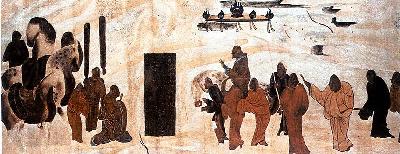
Throughout the history, the Silk Road saw unceasing changes to the routes in accordance with the evolution of geography, politics and religion. The Silk Road took on it shape today around the Han dynasties (BC 206-260 AD) with the West Han’s capital Chang’an (today’s Xi’an) or East Han’s capitalLuoyang(capital of the middleHenan Province) as its starting point. Then it went west through Jincheng (today’s Lanzhou, capital of westernGansu Province),Wuwei,Zhangye, Jiuquan andDunhuang, four ancient cities along the Gansu Hexi Corridor to the ancient state ofLoulan. The road did not stop at Loulan; it went on to the farther west through today’sXinjiangUygur Autonomous Region to countries far away from China like Afghanistan, Iran and east of the Roman Empire.
 Maritime Silk Road
The maritime Silk Road, like its overland counterpart, had its origins during the Han Dynasty (202 BC-220 AD). Although vast seas separate the four corners of the Earth, with advances in shipbuilding and navigational technologies, maritime transport came to provide unprecedented access to the most distant destinations. It is known that the bulk of the raw and processed silk transported along the overland Silk Road during the Han Dynasty was produced primarily along China's southern coast and in the coastal Wu, Wei, Qi, and Lu regions (present-dayShandong Province). Since ancient times, these areas have been thriving centers of shipbuilding as well as silk production. They were thus able to supply both commodities for export and the means to transport them across the sea. It was this combination that provided the social and material conditions necessary for the development of maritime trade during the Han Dynasty. The maritime routes opened by Emperor Han Wudi (reigned 140-87 BC) provided access to the Roman Empire via India. This enabled China to actively seek out overseas markets and establish foreign trade relations, and laid the foundation for the development of the maritime Silk Road.
During theTang Dynasty(618-907 AD), Chinese ships set sail fromGuangzhou, bound across the South China Sea, thus pioneering the most important routes of the maritime Silk Road. In addition to transporting silk, the South China Sea routes stimulated both material and cultural exchange. Countries throughout Southeast Asia, South Asia, West Asia, and even Europe dispatched emissaries to China via the new maritime routes to establish diplomatic relations, purchase silk, and engage of trade of all sorts. Silk, as the principal maritime trade commodity, flowed in a steady stream from China to other countries.









 Email to Friends
 Print
 Save