 |
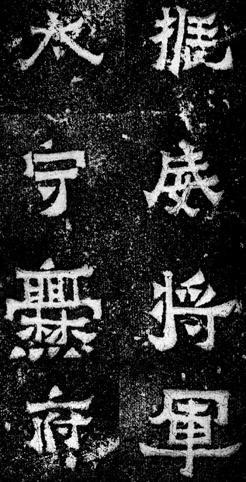
| part of Stele of Cuan Baozi |
The Stele of Cuan Baozi stands in the No.1 Middle School of Qujing City, Yunnan Province.
The Stele of Cuan Baozi was unearthed in the 43rd year(1778)of the Qianlong reign of the Qing Dynasty (1644-1911) in Yangqitian Village, Qujing City. In the second year (1852) of the Xianfeng reign, it was moved to the Wuhou Temple in Qujing City, and moved again to the No.1 Middle School of Qujing City in 1937.
This stele is also called "Xiaocuan Stele". It was erected in the 4th year (404) of the Daheng reign of the Eastern Jin Dynasty (317-420), being 1.83 m high, 0.68 m wide and 0.21 m thick. Its head is semicircular, and the top is inscribed with 15 characters in 5 lines, meaning it's the tomb of the late Mr. Cuan, satrap of Jianning and a general of the Jin Dynasty (265-420). The epigraph contains 400 characters in 13 lines, each line having 7 to 30 characters. At the end, there are 13 lines of superscription, each line having 4 characters, all in regular script. All the characters are clearly legible except one lost. The main content of the epigraph is about the life story of Cuan Baozi, his family background and political achievements. Cuan Baozi was the chieftain of the Cuan clan, a hereditary satrap of Jianning County. The Cuan's family was one of the famous "great surnames (families) of southern China" from the Eastern Han Dynasty (25-220) to the mid Tang Dynasty (618-907). Jianning (today's Qujing) and Jinning (today's Dianchi) were the central areas under the jurisdiction of Mr. Cuan. The superscriptions at the end of the epigraph have recorded the names of officials under the satrap of Jianning at that time, having a high historical value. In the left lower corner is a note by Deng Erheng of Nanning Prefecture in July of the second year (1852) of the Xianfeng reign of the Qing Dynasty (1644-1911), recording the story about this stele.
The handwriting of the epigraph is of primitive simplicity, characterized by straight turning of the strokes, reflecting the transition fromLishu(official script) toKaishu(regular script), and being an important evidence of the evolution of Chinese handwriting styles. In the history of chirography, this stele is called "Xiao Cuan (Small Cuan)", and together with the Stele of Cuan Longyan, they are called "Two Cuans".







 Email to Friends
 Print
Print Save
Save